2014 · Devices & clinical
Double waffle-cone technique using twin Solitaire detachable stents for treatment of an ultra-wide necked aneurysm
Rahal JP, Dandamudi VS, Safain MG, Malek AM.
J Clin Neurosci 21(6):1019-23, 2014.
PMID 24412295 · DOI 10.1016/j.jocn.2013.08.029
In plain language
Some brain aneurysms have necks so wide that coils placed inside them can slip out, and common stent techniques do not always work for aneurysms at awkward branch points. This report describes a new "double waffle-cone" technique for such a case.
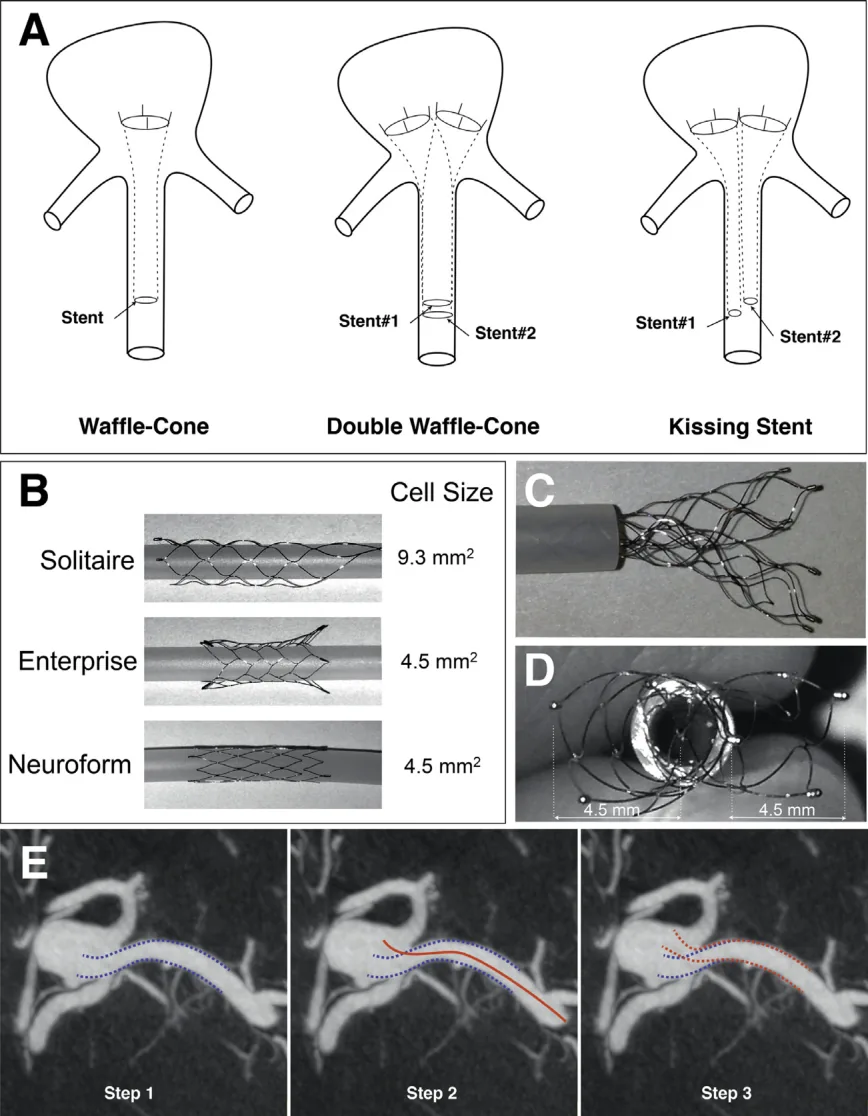
Two Solitaire stents, which have large openings in their mesh, were placed one inside the other, flaring at the aneurysm neck to double the area covered. Detailed cone-beam CT, a 3D scan done in the angiography room, helped fine-tune their position before release. The method allowed successful coiling of a very wide-necked middle cerebral artery aneurysm, with no strokes seen on MRI after the procedure and complete, stable treatment without narrowing inside the stent at 6 months.
A plain-language summary for patients and families. It is not medical advice, and individual results vary.
Abstract
Several stent-supported coiling techniques have been devised for treating wide-necked bifurcation aneurysms including the Y-stent and waffle-cone constructs. The Y-stent technique is not technically possible with obtusely oriented daughter vessels, and the waffle-cone method is inadequate for aneurysms with necks exceeding the stent's maximal expansion diameter. We describe here the novel use of the Solitaire electrolytically detachable slotted stent (Solitaire, ev3, Irvine, CA, USA) featuring large-sized cells to fashion a concentric "double waffle-cone" construct. This method enabled the doubling of the neck coverage to treat an ultra-wide necked middle cerebral aneurysm with obtusely oriented daughter branches. The technique relies on the intra-cell crossing of the first stent using the second stent delivery microcatheter and fine tuning the relative position with the aid of cross-sectional cone-beam computed tomographic angiography to achieve optimal coverage of the neck prior to detachment of the stents in position. A retrievable stent with large cells such as the Solitaire device is optimal for this application given the need for relative adjustment of the deployment before final stent release to avoid under- or over-penetration of the distal stent struts into the aneurysm dome. An additional advantage of this approach over the kissing-stent technique is the absence of intraluminal stent struts, which was confirmed here by down-the-barrel cross-sectional imaging. The double waffle-cone construct enabled the successful coiling of the aneurysm with no post-procedural ischemic events detected on diffusion-weighted MRI and with stable complete embolization and no residual filling or in-stent stenosis at 6 month follow-up.
Abstract as indexed in PubMed (PMID 24412295). Copyright the publisher.
Cite this paper
Rahal JP, Dandamudi VS, Safain MG, Malek AM. Double waffle-cone technique using twin Solitaire detachable stents for treatment of an ultra-wide necked aneurysm. J Clin Neurosci 21(6):1019-23. 2014. doi:10.1016/j.jocn.2013.08.029 PMID: 24412295.