2011 · Devices & clinical
Delivery technique plays an important role in determining vessel wall apposition of the Enterprise self-expanding intracranial stent
Heller RS, Malek AM.
J Neurointerv Surg 3(4):340-3, 2011.
PMID 21990459 · DOI 10.1136/jnis.2010.004499 · PMCID PMC3212648
In plain language
The Enterprise stent is a self-expanding metal mesh tube used to support coils in wide-necked brain aneurysms. This laboratory study tested whether the way the stent is released affects how well it hugs the wall of a curved vessel.
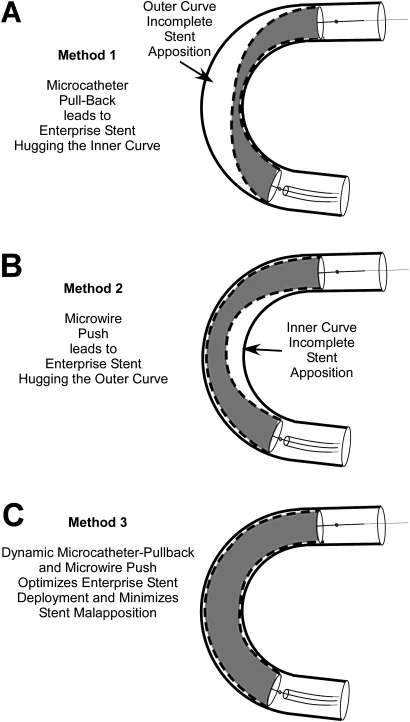
Stents were placed in a curved silicone tube 3.5 millimeters wide and imaged with high-resolution CT. Pulling back the delivery catheter, the method recommended by the manufacturer, left a gap on the outer side of the curve, while pushing the stent out with the wire left a gap on the inner side. Combining push and pull to keep the catheter tip centered reduced both gaps.
Because poor wall contact may be linked to clot complications, delivery technique matters even in mildly curved arteries.
A plain-language summary for patients and families. It is not medical advice, and individual results vary.
Abstract
Background
The Enterprise (EN) vascular reconstruction device is a self-expanding nitinol stent used as adjunctive support in wide-necked aneurysm coiling. We sought to evaluate the effect of deployment technique on how well the EN stent conforms to the vessel wall around a curve.
Methods
A flow model consisting of a 3.5 mm diameter silicone tube forming a 7 mm radius curve was visualized using high-resolution flat-panel CT (FPCT; DynaCT). EN stents (4.5 mm × 22 mm) were deployed using three methods: (1) microcatheter pull-back, (2) delivery microwire push and (3) a combination of both methods so as to keep the microcatheter tip centered within the lumen during deployment. FPCT images were visualized using multiplanar reconstruction for evidence of incomplete stent apposition (ISA).
Results
FPCT revealed a critical role for deployment method in stent-wall apposition as noted by the development of a crescent-shaped gap between the stent and the wall. Specifically, the manufacturer-recommended microcatheter pull-back unsheathing technique (method 1) resulted in outer curve ISA, while the microwire push technique (method 2) led to inner curve ISA. Using method 3 in a dynamic push-pull manner minimized both inner and outer curve ISA.
Conclusion
The deployment method used to deliver the EN vascular reconstruction device plays a critical role in determining how well its struts appose the vessel wall in vitro. This characteristic must be taken into account when deploying this flexible low-profile stent to avoid ISA in even mildly tortuous anatomy given the possible link between stent malapposition and thromboembolic complications.
Abstract as indexed in PubMed (PMID 21990459). Copyright the publisher.
Cite this paper
Heller RS, Malek AM. Delivery technique plays an important role in determining vessel wall apposition of the Enterprise self-expanding intracranial stent. J Neurointerv Surg 3(4):340-3. 2011. doi:10.1136/jnis.2010.004499 PMID: 21990459.