2012 · Devices & clinical
Double-barrel entanglement of intracranial Enterprise stents resulting from undetected incomplete stent apposition
Heller RS, Safain M, Malek AM.
J Neurointerv Surg 4(6):e38, 2012.
PMID 22231279 · DOI 10.1136/neurintsurg-2011-010192
In plain language
Stents used to support coiling of brain aneurysms can sometimes fail to press fully against the artery wall around tight bends. This case report describes a 49-year-old woman, treated earlier with an Enterprise stent and coils for a carotid artery aneurysm near the eye, who needed more treatment because the aneurysm was still filling.
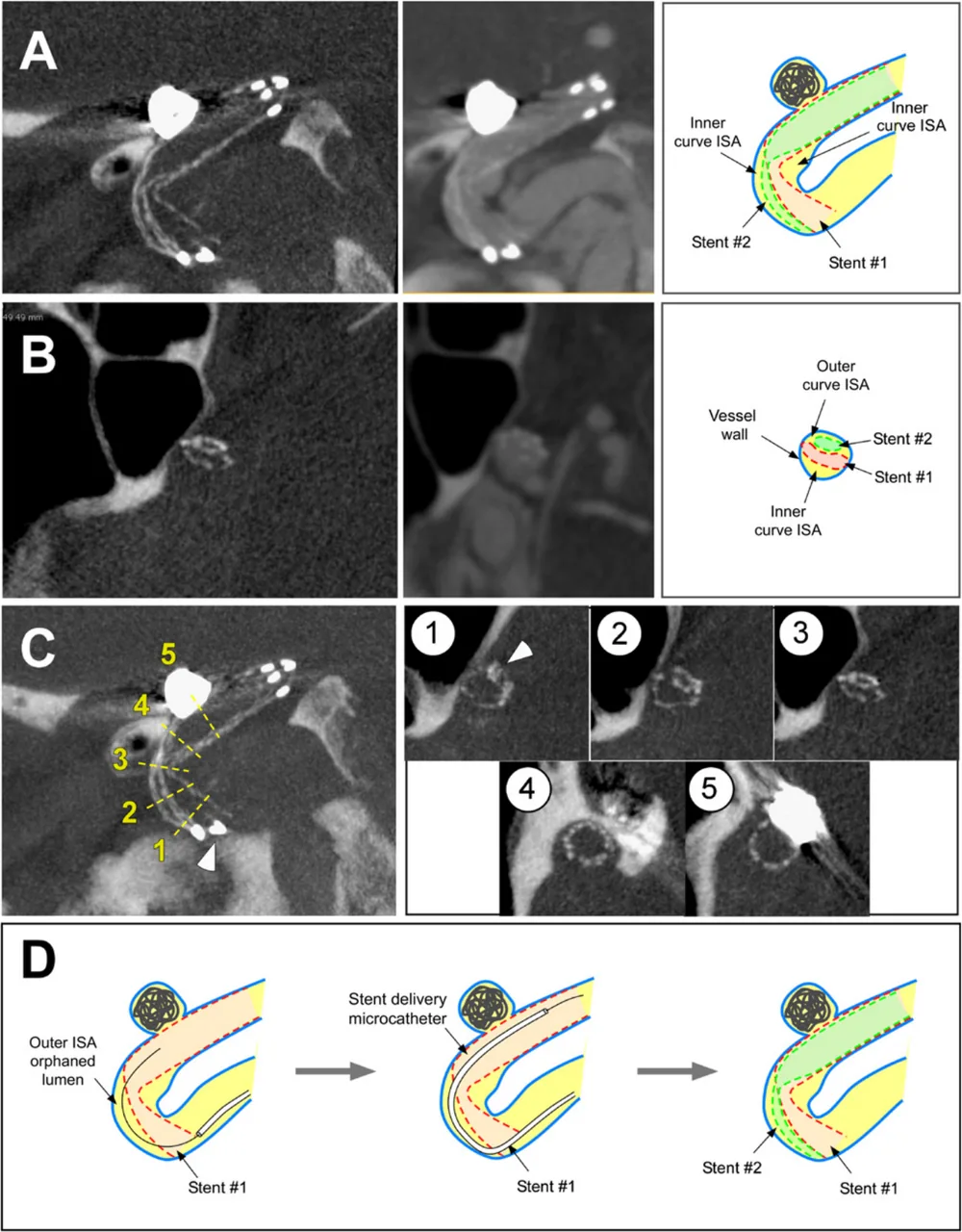
During the second procedure, a new stent did not open fully. A cone beam CT scan showed it had passed into and out of the gap behind the first, poorly apposed stent, creating a tangled, two-channel segment in the curved part of the artery.
The authors urge caution when passing devices through earlier stents in curved vessels and note that CT imaging can help.
A plain-language summary for patients and families. It is not medical advice, and individual results vary.
Abstract
Objective
Although intracranial stents have expanded the spectrum of aneurysms amenable to coiling, closed cell design variants can be prone to incomplete stent apposition around tightly curved arterial bends. A case is presented illustrating the technical ramifications of this phenomenon during subsequent treatment.
Clinical presentation
A 49-year-old woman who had previously undergone Enterprise (closed cell design) stent mediated coiling of a wide necked ophthalmic carotid artery aneurysm was noted to harbor residual central filling on follow-up imaging, and was scheduled for additional embolization.
Intervention
During retreatment, performed with a second concentrically placed Enterprise and further coil packing using the jailing technique, the proximal portion of the second Enterprise stent failed to expand as expected. C-arm cone beam CT (CBCT) revealed the second stent to have been navigated into and out of the orphaned lumen created by the incompletely apposed first Enterprise stent at the carotid siphon. This stent entanglement resulted in the formation of a trapped proximal double-barrel lumen in the curved segment and resolution to a single barrel lumen in the distal straight segment of the parent vessel facing the aneurysm neck.
Conclusion
Caution is urged when navigating around curved vessel segments through previously deployed intracranial stents, which may be incompletely apposed to the vessel wall, to avoid deleterious and potentially catastrophic entanglement. CBCT imaging may be helpful in delineating the spatial relationship of previously deployed intracranial stents during subsequent endovascular navigation.
Abstract as indexed in PubMed (PMID 22231279). Copyright the publisher.
Cite this paper
Heller RS, Safain M, Malek AM. Double-barrel entanglement of intracranial Enterprise stents resulting from undetected incomplete stent apposition. J Neurointerv Surg 4(6):e38. 2012. doi:10.1136/neurintsurg-2011-010192 PMID: 22231279.