2015 · Devices & clinical
Enterprise stenting for intracranial aneurysm treatment induces dynamic and reversible age-dependent stenosis in cerebral arteries
Gao B, Safain MG, Malek AM.
J Neurointerv Surg 7(4):297-302, 2015.
PMID 24651613 · DOI 10.1136/neurintsurg-2013-011074
In plain language
Stents are small mesh tubes often used to help hold coils inside brain aneurysms. Narrowing inside a stent can develop over time, but how brain arteries respond to the Enterprise stent in particular was not well understood.
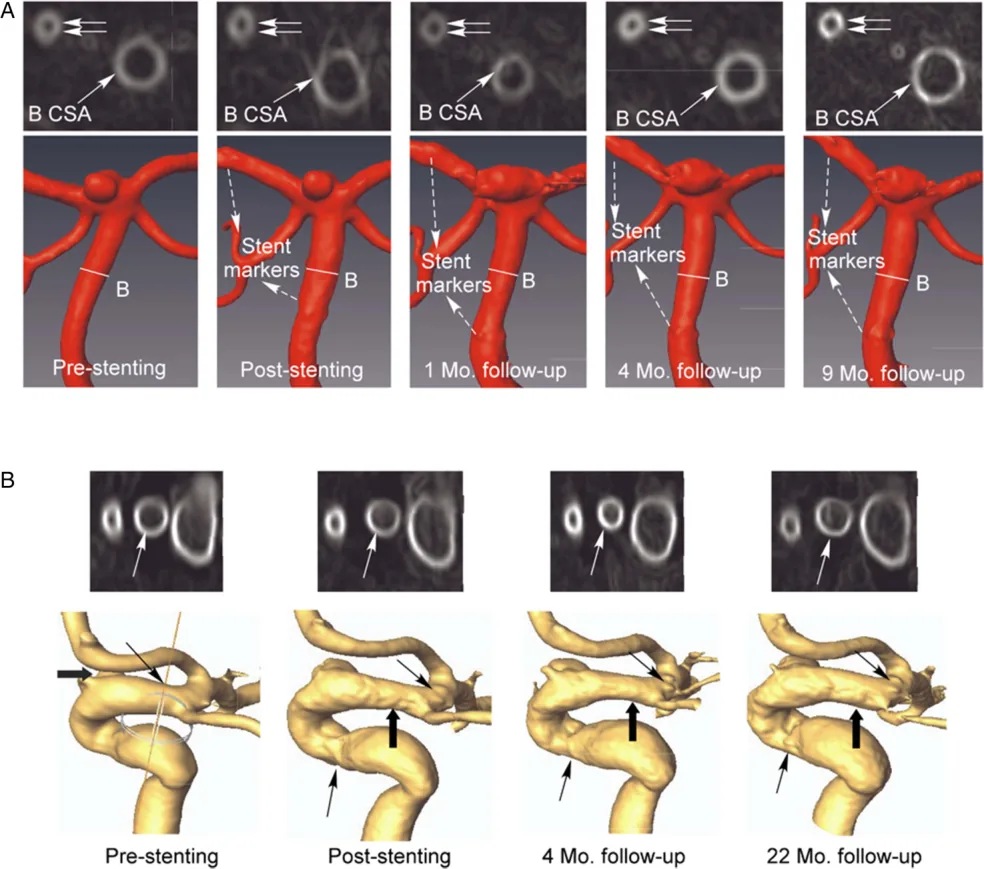
The authors studied 77 patients with 88 aneurysms treated with Enterprise stents and coils, using detailed 3D angiogram images and precise measurements at several points along each stent. Right after placement, the artery widened by 8.98% at one end of the stent. Then, 4 to 6 months later, the artery inside and around the stent narrowed significantly, by between 10.68% and 32.12% depending on location. This narrowing fully resolved by 12 to 24 months, and it was stronger in younger patients. No narrowing was severe enough to limit flow or need treatment.
Whether this temporary narrowing has any clinical effect needs further study.
A plain-language summary for patients and families. It is not medical advice, and individual results vary.
Abstract
Background
Although intracranial stenting has been associated with in-stent stenosis, the vascular response of cerebral vessels to the deployment of the Enterprise vascular reconstruction device is poorly defined.
Objective
To evaluate the change in parent vessel caliber that ensues after Enterprise stent placement.
Methods
Seventy-seven patients with 88 aneurysms were treated using Enterprise stent-assisted coil embolization and underwent high-resolution three-dimensional rotational angiography followed by three-dimensional edge-detection filtering to remove windowing-dependence measurement artifact. Orthogonal diameters and cross-sectional areas (CSAs) were measured proximal and distal on either side of the leading stent edge (points A, B), trailing stent edge (points D, E), and at mid-stent (point C).
Results
Enterprise stent deployment caused an instant increase in the parent artery CSA by 8.98% at D, which was followed 4-6 months later by significant in-stent stenosis (15.78% at A, 27.24% at B, 10.68% at C, 32.12% at D, and 28.28% at E) in the stented artery. This time-dependent phenomenon showed resolution which was complete by 12-24 months after treatment. This target vessel stenosis showed significant age dependence with greater response in the young. No flow-limiting stenosis requiring treatment was observed in this series.
Conclusions
Use of the Enterprise stent is associated with a significant dynamic and spontaneously resolvable age-dependent in-stent stenosis. Further study is warranted on the clinical impact, if any, of this occurrence.
Abstract as indexed in PubMed (PMID 24651613). Copyright the publisher.
Cite this paper
Gao B, Safain MG, Malek AM. Enterprise stenting for intracranial aneurysm treatment induces dynamic and reversible age-dependent stenosis in cerebral arteries. J Neurointerv Surg 7(4):297-302. 2015. doi:10.1136/neurintsurg-2013-011074 PMID: 24651613.