2019 · Devices & clinical
Neuroform Atlas Stent System for the treatment of intracranial aneurysm: primary results of the Atlas Humanitarian Device Exemption cohort
Jankowitz BT, Hanel R, Jadhav AP, Loy DN, Frei D, Siddiqui AH, Puri AS, Khaldi A, Turk AS, Malek AM, Sauvageau E, Hetts SW, Zaidat OO.
J Neurointerv Surg 11(8):801-806, 2019.
PMID 30670625 · DOI 10.1136/neurintsurg-2018-014455 · PMCID PMC6703120
In plain language
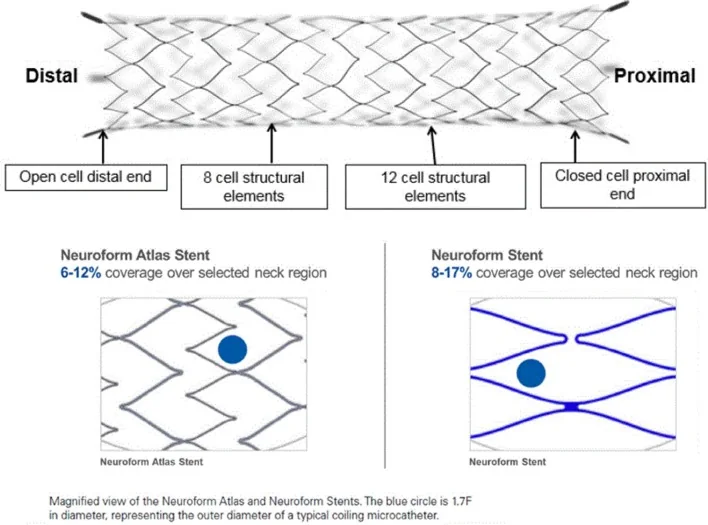
Aneurysms with a wide opening are hard to fill with coils alone, because the coils can fall back into the artery. A small stent placed across the opening can hold them in place. This report covers the first results with a new generation stent, the Neuroform Atlas.
Thirty patients with unruptured wide necked aneurysms were treated at eight US centers, and 27 returned for angiography one year later. The stent was placed successfully in every case. Complete closure without retreatment or significant narrowing of the parent artery was seen in 26 of 30 patients (86.7 percent) by one accounting method and in 25 of 27 patients (92.6 percent) among those with one year imaging. One patient (3.3 percent) had a stroke and recovered completely, and there were no deaths from neurological causes.
A plain-language summary for patients and families. It is not medical advice, and individual results vary.
Abstract
Background and objective
Stent-assisted coil embolization is a well-established treatment of intracranial wide-necked aneurysms. The Neuroform Atlas Stent System is a new generation microstent designed to enhance coil support, conformability, deliverability, and improve deployment accuracy. We present the 1-year efficacy and angiographic results of the Humanitarian Device Exemption (HDE) cohort from the Atlas Investigational Device Exemption (IDE) clinical trial.
Method
The Atlas IDE trial is a prospective, multicenter, single-arm, open-label study of unruptured wide-necked intracranial aneurysms treated with the Neuroform Atlas stent and approved coils. The primary efficacy endpoint was the rate of 12-month complete aneurysm angiographic occlusion (Raymond class I) without target aneurysm retreatment or significant parent artery stenosis (>50%) at the target location. The primary safety endpoint was the rate of major ipsilateral stroke or neurological death within 12 months. Imaging core laboratory and Clinical EventsCommittee adjudicated the primary endpoints.
Results
30 patients were enrolled at eight US centers, with 27 patients completing the 12-month angiographic follow-up. The mean age was 59.4±11.8 years and 24/30 patients (80%) were women. The mean aneurysm size was 5.3±1.7 mm and the dome:neck ratio was 1.1±0.2. Procedural technical success of Neuroform Atlas Stent deployment was 100%. 27 patients completed 12-month angiographic follow-up and 30 patients completed their 6-month follow-up. When applying the last observation carried forward method, the primary efficacy endpoint was observed in 26/30 patients (86.7%, 95% CI 69.3% to 96.2%) compared with 25/27 patients (92.6%, 95% CI 75.7% to 99.1%) who completed the 12-month angiographic follow-up. The primary safety endpoint of stroke occurred in one patient (3.3%), who made a complete clinical recovery at discharge. There were no neurological deaths.
Conclusion
The Neuroform Atlas stent in conjunction with coils demonstrated a high rate of complete aneurysm occlusion at 12-month angiographic follow-up, with an improved safety profile in the HDE cohort.
Clinical trialgov registration number
NCT0234058;Results.
Abstract as indexed in PubMed (PMID 30670625). Copyright the publisher.
Cite this paper
Jankowitz BT, Hanel R, Jadhav AP, Loy DN, Frei D, Siddiqui AH, Puri AS, Khaldi A, Turk AS, Malek AM, Sauvageau E, Hetts SW, Zaidat OO. Neuroform Atlas Stent System for the treatment of intracranial aneurysm: primary results of the Atlas Humanitarian Device Exemption cohort. J Neurointerv Surg 11(8):801-806. 2019. doi:10.1136/neurintsurg-2018-014455 PMID: 30670625.