2020 · Devices & clinical
Prospective study on embolization of intracranial aneurysms with the pipeline device: the PREMIER study 1 year results
Hanel RA, Kallmes DF, Lopes DK, Nelson PK, Siddiqui A, Jabbour P, Pereira VM, Szikora István I, Zaidat OO, Bettegowda C, Colby GP, Mokin M, Schirmer C, Hellinger FR, Given Ii C, Krings T, Taussky P, Toth G, Fraser JF, Chen M, Priest R, Kan P, Fiorella D, Frei D, Aagaard-Kienitz B, Diaz O, Malek AM, Cawley CM, Puri AS.
J Neurointerv Surg 12(1):62-66, 2020.
PMID 31308197 · DOI 10.1136/neurintsurg-2019-015091 · PMCID PMC6996098
In plain language
A flow diverter is a fine mesh tube placed in the artery across the mouth of an aneurysm, redirecting blood past it so the aneurysm gradually seals itself. The PREMIER trial tested this approach in small and medium aneurysms with a wide opening.
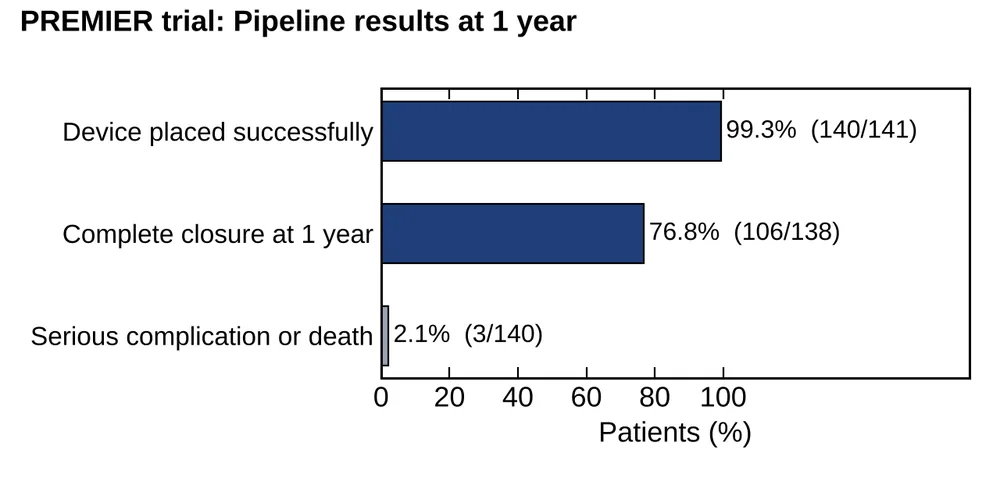
At several centers, 141 patients with unruptured aneurysms of 12 millimeters or less on the internal carotid or vertebral artery were treated with the Pipeline device between July 2014 and November 2015. Placement succeeded in 140 of 141 patients (99.3 percent), and most needed only a single device. At one year, 106 of 138 patients with follow up imaging (76.8 percent) had complete closure without significant narrowing of the artery or need for retreatment. Serious complications or death occurred in 3 of 140 patients (2.1 percent).
A plain-language summary for patients and families. It is not medical advice, and individual results vary.
Abstract
Background
Preliminary clinical studies on the safety and efficacy of the pipeline embolization device (PED) for the treatment of small/medium aneurysms have demonstrated high occlusion rates with low complications.
Objective
To evaluate the safety and effectiveness of the PED for treatment of wide necked small and medium intracranial aneurysms.
Methods
PREMIER is a prospective, multicenter, single arm trial. Patients were treated with the PED for unruptured wide necked aneurysms, measuring ≤12 mm along the internal carotid artery or vertebral artery, between July 2014 and November 2015. At 1 year post-procedure, the primary effectiveness endpoint was complete occlusion (Raymond grade 1) without major parent vessel stenosis (≤50%) or retreatment, and the primary safety endpoint was major stroke in the territory supplied by the treated artery or neurologic death.
Results
A total of 141 patients were treated with PEDs (mean age 54.6±11.3 years, 87.9% (124/141) women). Mean aneurysm size was 5.0±1.92 mm, and 84.4% (119/141) measured <7 mm. PED placement was successful in 99.3% (140/141) of patients. Mean number of PEDs implanted per patient was 1.1±0.26; a single PED was used in 92.9% (131/141) of patients. At 1 year, 97.9% (138/141) of patients underwent follow-up angiography with 76.8% (106/138) of patients having met the study's primary effectiveness endpoint. The combined major morbidity and mortality rate was 2.1% (3/140).
Conclusions
Treatment of wide necked small/medium aneurysms with the PED results in high rates of complete occlusion without significant parent vessel stenosis and low rates of permanent neurologic complications.
Trial registration
NCT02186561.
Abstract as indexed in PubMed (PMID 31308197). Copyright the publisher.
Cite this paper
Hanel RA, Kallmes DF, Lopes DK, Nelson PK, Siddiqui A, Jabbour P, Pereira VM, Szikora István I, Zaidat OO, Bettegowda C, Colby GP, Mokin M, Schirmer C, Hellinger FR, Given Ii C, Krings T, Taussky P, Toth G, Fraser JF, Chen M, Priest R, Kan P, Fiorella D, Frei D, Aagaard-Kienitz B, Diaz O, Malek AM, Cawley CM, Puri AS. Prospective study on embolization of intracranial aneurysms with the pipeline device: the PREMIER study 1 year results. J Neurointerv Surg 12(1):62-66. 2020. doi:10.1136/neurintsurg-2019-015091 PMID: 31308197.