2023 · Devices & clinical
Prospective study on embolization of intracranial aneurysms with the pipeline device (PREMIER study): 3-year results with the application of a flow diverter specific occlusion classification
Hanel RA, Cortez GM, Lopes DK, Nelson PK, Siddiqui AH, Jabbour P, Mendes Pereira V, István IS, Zaidat OO, Bettegowda C, Colby GP, Mokin M, Schirmer CM, Hellinger FR, Given C, Krings T, Taussky P, Toth G, Fraser JF, Chen M, Priest R, Kan P, Fiorella D, Frei D, Aagaard-Kienitz B, Diaz O, Malek AM, Cawley CM, Puri AS, Kallmes DF.
J Neurointerv Surg 15(3):248-254, 2023.
PMID 35292570 · DOI 10.1136/neurintsurg-2021-018501 · PMCID PMC9985759
In plain language
The Pipeline device is a flow diverter, a fine mesh tube placed inside an artery to redirect blood away from an aneurysm so it can heal. The PREMIER trial followed patients with unruptured, wide-necked aneurysms up to 12 millimeters to see how well the device works over time.
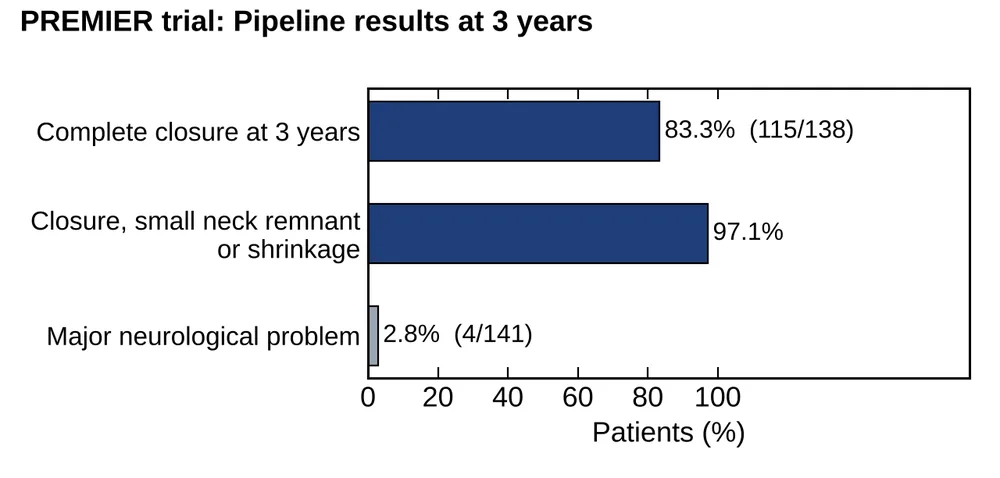
Of 141 treated patients, 83.3% (115 of 138) had complete aneurysm closure at 3 years. Using a scale designed for flow diverters, closure, a small leftover neck, or shrinkage was seen in 97.1%. Major neurologic problems occurred in 2.8% (4 of 141), with only one after the first year. There was one aneurysm recurrence and no delayed ruptures.
The results support the device as safe and durable for small and medium aneurysms.
A plain-language summary for patients and families. It is not medical advice, and individual results vary.
Abstract
Background
The pipeline embolization device (PED; Medtronic) has presented as a safe and efficacious treatment for small- and medium-sized intracranial aneurysms. Independently adjudicated long-term results of the device in treating these lesions are still indeterminate. We present 3-year results, with additional application of a flow diverter specific occlusion scale.
Methods
PREMIER (prospective study on embolization of intracranial aneurysms with pipeline embolization device) is a prospective, single-arm trial. Inclusion criteria were patients with unruptured wide-necked intracranial aneurysms ≤12 mm. Primary effectiveness (complete aneurysm occlusion) and safety (major neurologic event) endpoints were independently monitored and adjudicated.
Results
As per the protocol, of 141 patients treated with a PED, 25 (17.7%) required angiographic follow-up after the first year due to incomplete aneurysm occlusion. According to the Core Radiology Laboratory review, three (12%) of these patients progressed to complete occlusion, with an overall rate of complete aneurysm occlusion at 3 years of 83.3% (115/138). Further angiographic evaluation using the modified Cekirge-Saatci classification demonstrated that complete occlusion, neck residual, or aneurysm size reduction occurred in 97.1%. The overall combined safety endpoint at 3 years was 2.8% (4/141), with only one non-debilitating major event occurring after the first year. There was one case of aneurysm recurrence but no cases of delayed rupture in this series.
Conclusions
The PED device presents as a safe and effective modality in treating small- and medium-sized intracranial aneurysms. The application of a flow diverter specific occlusion classification attested the long-term durability with higher rate of successful aneurysm occlusion and no documented aneurysm rupture.
Trial registration
NCT02186561.
Abstract as indexed in PubMed (PMID 35292570). Copyright the publisher.
Cite this paper
Hanel RA, Cortez GM, Lopes DK, Nelson PK, Siddiqui AH, Jabbour P, Mendes Pereira V, István IS, Zaidat OO, Bettegowda C, Colby GP, Mokin M, Schirmer CM, Hellinger FR, Given C, Krings T, Taussky P, Toth G, Fraser JF, Chen M, Priest R, Kan P, Fiorella D, Frei D, Aagaard-Kienitz B, Diaz O, Malek AM, Cawley CM, Puri AS, Kallmes DF. Prospective study on embolization of intracranial aneurysms with the pipeline device (PREMIER study): 3-year results with the application of a flow diverter specific occlusion classification. J Neurointerv Surg 15(3):248-254. 2023. doi:10.1136/neurintsurg-2021-018501 PMID: 35292570.