2026 · Devices & clinical
Early angiographic response to Pipeline Vantage flow diverter embolization of intracranial carotid aneurysms
Snyder MH, Malek AM.
J Neurointerv Surg 18(7):1625-1631, 2026.
PMID 40889893 · DOI 10.1136/jnis-2025-023567
In plain language
This study reports early results with the Pipeline Vantage 027, a newer flow diverter (a fine mesh tube that seals off an aneurysm from the inside), used to treat aneurysms of the internal carotid artery, a main artery supplying the front of the brain. Twenty patients with 24 aneurysms were treated at Tufts in 2024.
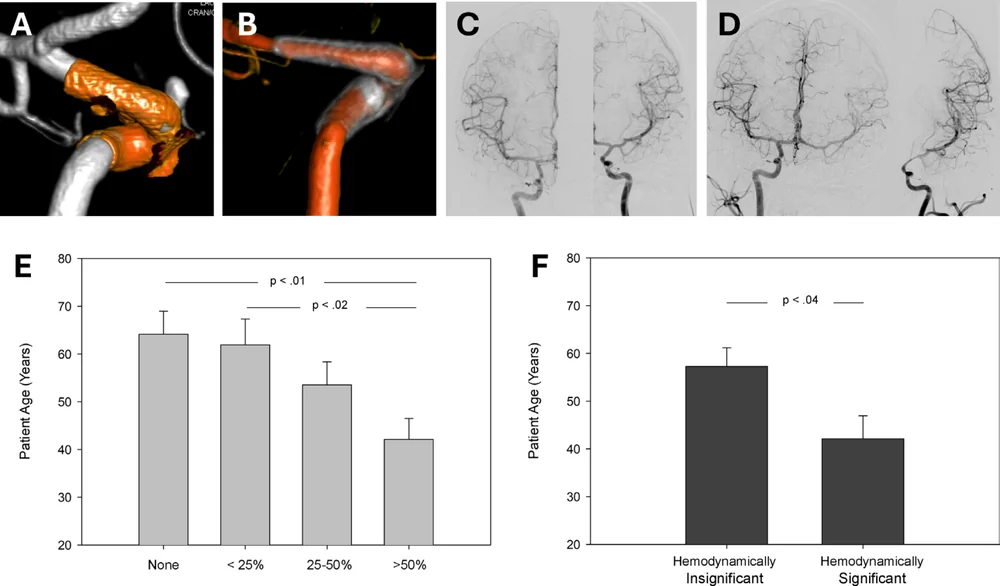
Within about three and a half months, 79% of the aneurysms had completely closed. There were no strokes at six months, apart from one temporary episode in a patient who stopped the prescribed antiplatelet medicine. Some devices, especially in younger patients, developed a narrowing at one end or a small ledge that partly narrowed the artery.
These patients may need antiplatelet medicine for longer, and the authors recommend further study of how arteries respond to these devices.
A plain-language summary for patients and families. It is not medical advice, and individual results vary.
Abstract
Background
The Pipeline Vantage 027 flow diverter became available a year ago in the United States. We report an observational study of its safety and early angiographic response in the treatment of internal carotid artery (ICA) aneurysms.
Methods
All patients treated with the Vantage 027 for ICA aneurysms from April to November 2024 at a single center were included. Intraprocedural contrast-enhanced cone-beam CT was used to evaluate vessel wall apposition. A novel proximal ledge deformity is defined as delayed elevation of one stent edge into the lumen while the opposite edge remains wall-apposed.
Results
Twenty-four aneurysms (mean size 4.2±2.7 mm) in 20 patients underwent Vantage 027 embolization. Clinical follow-up at 6 months revealed no major/minor stroke and a single reversible ischemic attack following dual anti-platelet therapy (DAPT) non-compliance. Follow-up angiography in all patients revealed complete occlusion in 19/24 aneurysms at a median of 3.5 months (79%). Severe ≥50% stenosis was noted in 7/20 (35%) with distal fishmouth deformity in 12/20 (60%); both fishmouthing (p=0.003) and severe stenosis (p=0.04) were associated with younger age. We also observed a proximal ledge in 5/20 (25%) with luminal caliber compromise.
Conclusions
Although Vantage 027 ICA aneurysm embolization resulted in early robust aneurysm involution, it was associated with an age-dependent fishmouthing braid deformity and a proximal ledge deformity possibly requiring extended DAPT. These results encourage further analysis of the vascular response to Vantage 027 and similar stents.
Abstract as indexed in PubMed (PMID 40889893). Copyright the publisher.
Cite this paper
Snyder MH, Malek AM. Early angiographic response to Pipeline Vantage flow diverter embolization of intracranial carotid aneurysms. J Neurointerv Surg 18(7):1625-1631. 2026. doi:10.1136/jnis-2025-023567 PMID: 40889893.