2016 · Devices & clinical
Flow Diverter Therapy With the Pipeline Embolization Device Is Associated With an Elevated Rate of Delayed Fluid-Attenuated Inversion Recovery Lesions
Safain MG, Roguski M, Heller RS, Malek AM.
Stroke 47(3):789-97, 2016.
PMID 26903583 · DOI 10.1161/STROKEAHA.115.010522
In plain language
The Pipeline Embolization Device is a flow diverter, a finely woven mesh tube placed in the artery to redirect blood away from an aneurysm so it slowly seals off. Because blood keeps flowing through the mesh into the aneurysm for a while, the authors wondered whether this might lead to tiny clots traveling into the brain.
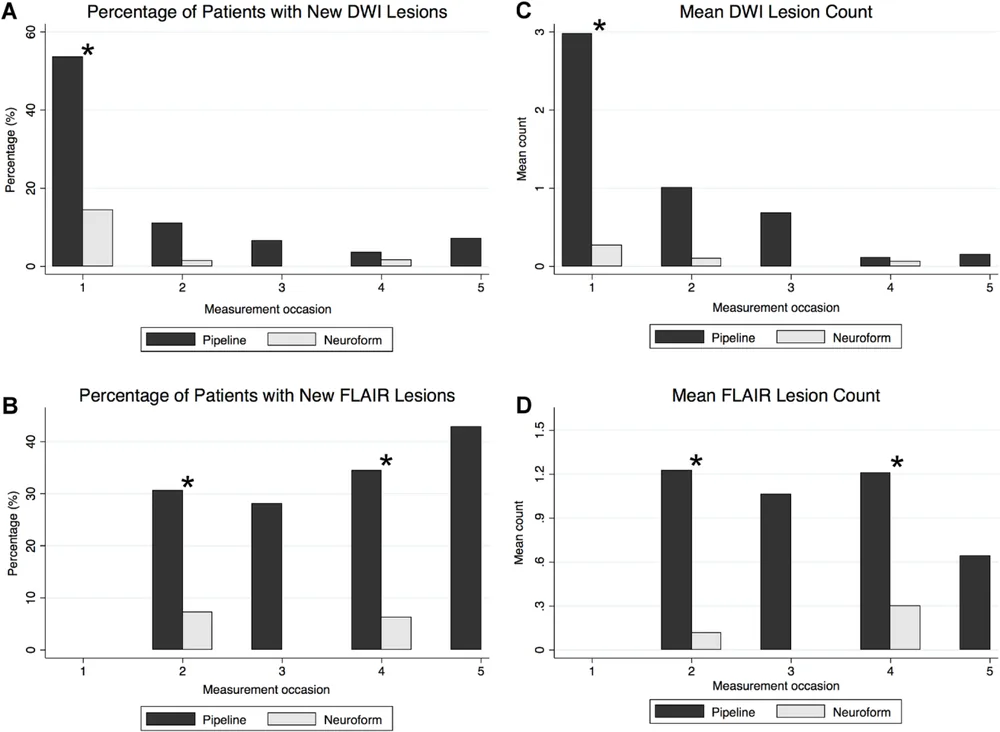
They compared 41 patients treated with Pipeline with 78 patients treated with a Neuroform stent and coils, using repeated MRI scans. Pipeline patients were much more likely to develop new FLAIR lesions, small spots of abnormal signal on MRI, on the treated side: 34% (14 of 41) at any time, compared with 10% (8 of 78) in the comparison group. These delayed spots were not predicted by scans taken right after the procedure.
The cause and clinical meaning of these lesions remain unknown, and the authors recommend careful follow-up.
A plain-language summary for patients and families. It is not medical advice, and individual results vary.
Abstract
Background and purpose
Flow diversion using the Pipeline Embolization Device is reported as a safe treatment of aneurysms. Complete aneurysm occlusion, however, occurs in a delayed fashion with initial persistent filling of the aneurysm dome. We hypothesized that this transflow across metallic struts may be associated with thromboembolic events.
Methods
Forty-one consecutive patients undergoing aneurysm treatment with the Pipeline Embolization Device and a comparison group of 78 Neuroform stent-mediated embolizations were studied. Patients' charts, procedure notes, platelet function, and anticoagulation state were analyzed. Serial magnetic resonance images were assessed for the presence of newly occurring diffusion-weighted imaging and fluid-attenuated inversion recovery (FLAIR) lesions at multiple postprocedure time ranges (average days post procedure [Pipeline Embolization Device/Neuroform]: T1=1, T2=73/107, T3=174, T4=277/335, and T5=409). In addition, diffusion-weighted imaging or FLAIR burden was estimated by lesional diameter summation.
Results
Pipeline patients were more likely to have new ipsilateral FLAIR lesions at all time points studied (30.6% versus 7.2% of patients at T=2 and 34.5% versus 6.2% at T=4). The mean FLAIR burden was significantly increased for Pipeline patients (10.1 versus 0.7 mm at T=2 and 8.8 versus 1.9 mm at T=4). Overall 34% (14/41) of Pipeline patients experienced a new FLAIR lesion at anytime when compared with 10% (8/78) of Neuroform stent-coil patients. Postprocedural diffusion-weighted imaging did not predict future FLAIR lesions suggesting a nonprocedural cause.
Conclusions
The Pipeline Embolization Device is associated with increased rate of de novo FLAIR lesions occurring in a delayed fashion and distinct from perioperative diffusion-weighted imaging lesions. The cause and clinical effect of these lesions are unknown and suggest the need for prudent follow-up and evaluation.
Abstract as indexed in PubMed (PMID 26903583). Copyright the publisher.
Cite this paper
Safain MG, Roguski M, Heller RS, Malek AM. Flow Diverter Therapy With the Pipeline Embolization Device Is Associated With an Elevated Rate of Delayed Fluid-Attenuated Inversion Recovery Lesions. Stroke 47(3):789-97. 2016. doi:10.1161/STROKEAHA.115.010522 PMID: 26903583.