2013 · Hemodynamics & imaging
Size ratio performance in detecting cerebral aneurysm rupture status is insensitive to small vessel removal
Lauric A, Baharoglu MI, Malek AM.
Neurosurgery 72(4):547-54; discussion 553-4, 2013.
PMID 23246822 · DOI 10.1227/NEU.0b013e318282a513
In plain language
Size ratio compares the size of an aneurysm with the size of the blood vessel it sits on, and it helps tell ruptured from unruptured aneurysms. It is calculated differently for aneurysms on the side of a vessel and those at a branch point, which causes confusion when a tiny branch arises near the aneurysm.
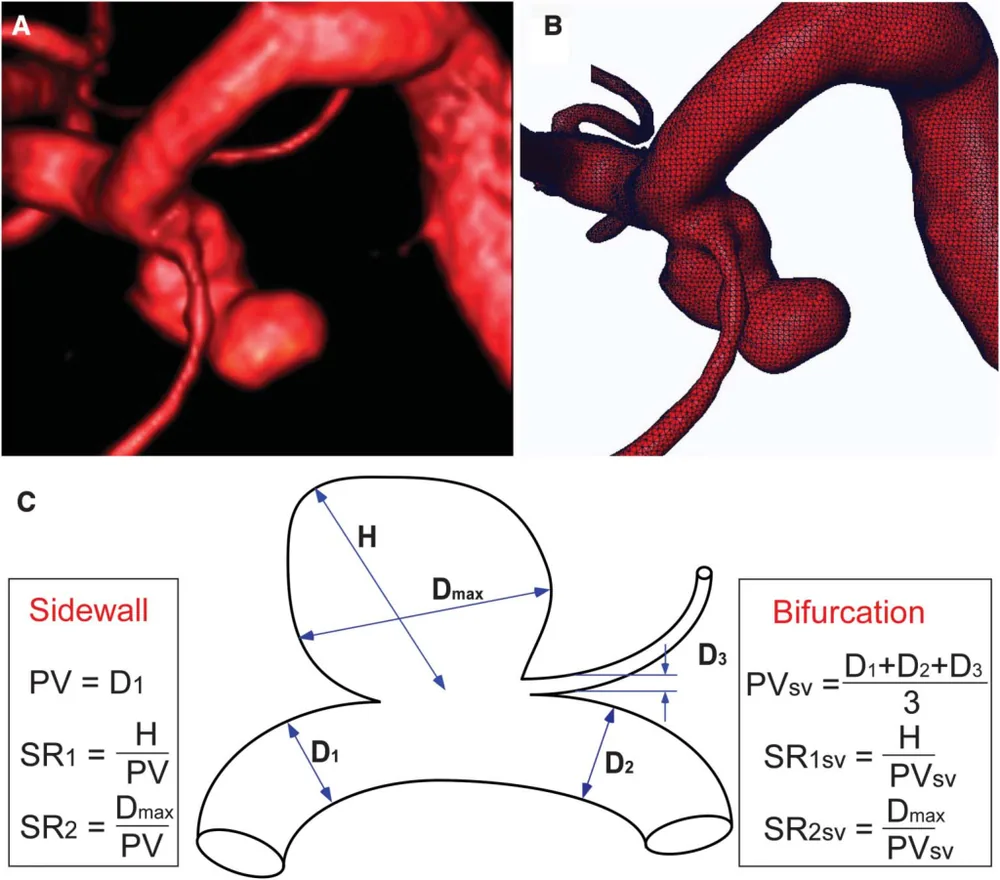
Using 3D angiography images of 134 aneurysms, 60 of them ruptured, the authors calculated size ratio both counting and ignoring these small branches. Size ratio separated ruptured from unruptured aneurysms equally well either way, and the two calculations agreed very closely (R² of 0.94 overall).
Ignoring small branches simplifies the measurement without losing accuracy, and the usual clinical labels can be used.
A plain-language summary for patients and families. It is not medical advice, and individual results vary.
Abstract
Background
The variable definition of size ratio (SR) for sidewall (SW) vs bifurcation (BIF) aneurysms raises confusion for lesions harboring small branches, such as carotid ophthalmic or posterior communicating locations. These aneurysms are considered SW by many clinicians, but SR methodology classifies them as BIF.
Objective
To evaluate the effect of ignoring small vessels and SW vs stringent BIF labeling on SR ruptured aneurysm detection performance in borderline aneurysms with small branches, and to reconcile SR-based labeling with clinical SW/BIF classification.
Methods
Catheter rotational angiographic datasets of 134 consecutive aneurysms (60 ruptured) were automatically measured in 3-dimensional. Stringent BIF labeling was applied to clinically labeled aneurysms, with 21 aneurysms switching label from SW to BIF. Parent vessel size was evaluated both taking into account, and ignoring, small vessels. SR was defined accordingly as the ratio between aneurysm and parent vessel sizes. Univariate and multivariate statistics identified significant features. The square of the correlation coefficient (R(2)) was reported for bivariate analysis of alternative SR calculations.
Results
Regardless of SW/BIF labeling method, SR was equally significant in discriminating aneurysm ruptured status (P < .001). Bivariate analysis of alternative SR had a high correlation of R(2) = 0.94 on the whole dataset, and R = 0.98 on the 21 borderline aneurysms.
Conclusion
Ignoring small branches from SR calculation maintains rupture status detection performance, while reducing postprocessing complexity and removing labeling ambiguity. Aneurysms adjacent to these vessels can be considered SW for morphometric analysis. It is reasonable to use the clinical SW/BIF labeling when using SR for rupture risk evaluation.
Abstract as indexed in PubMed (PMID 23246822). Copyright the publisher.
Cite this paper
Lauric A, Baharoglu MI, Malek AM. Size ratio performance in detecting cerebral aneurysm rupture status is insensitive to small vessel removal. Neurosurgery 72(4):547-54; discussion 553-4. 2013. doi:10.1227/NEU.0b013e318282a513 PMID: 23246822.