2021 · Hemodynamics & imaging
Performance of Radiomics derived morphological features for prediction of aneurysm rupture status
Ludwig CG, Lauric A, Malek JA, Mulligan R, Malek AM.
J Neurointerv Surg 13(8):755-761, 2021.
PMID 33158993 · DOI 10.1136/neurintsurg-2020-016808
In plain language
The shape and size of a brain aneurysm are linked to whether it has ruptured, and researchers have long used hand picked measurements such as an aneurysm's height relative to its neck. Radiomics, a technique that automatically extracts many shape and texture measurements from medical images, has been proposed as an alternative.
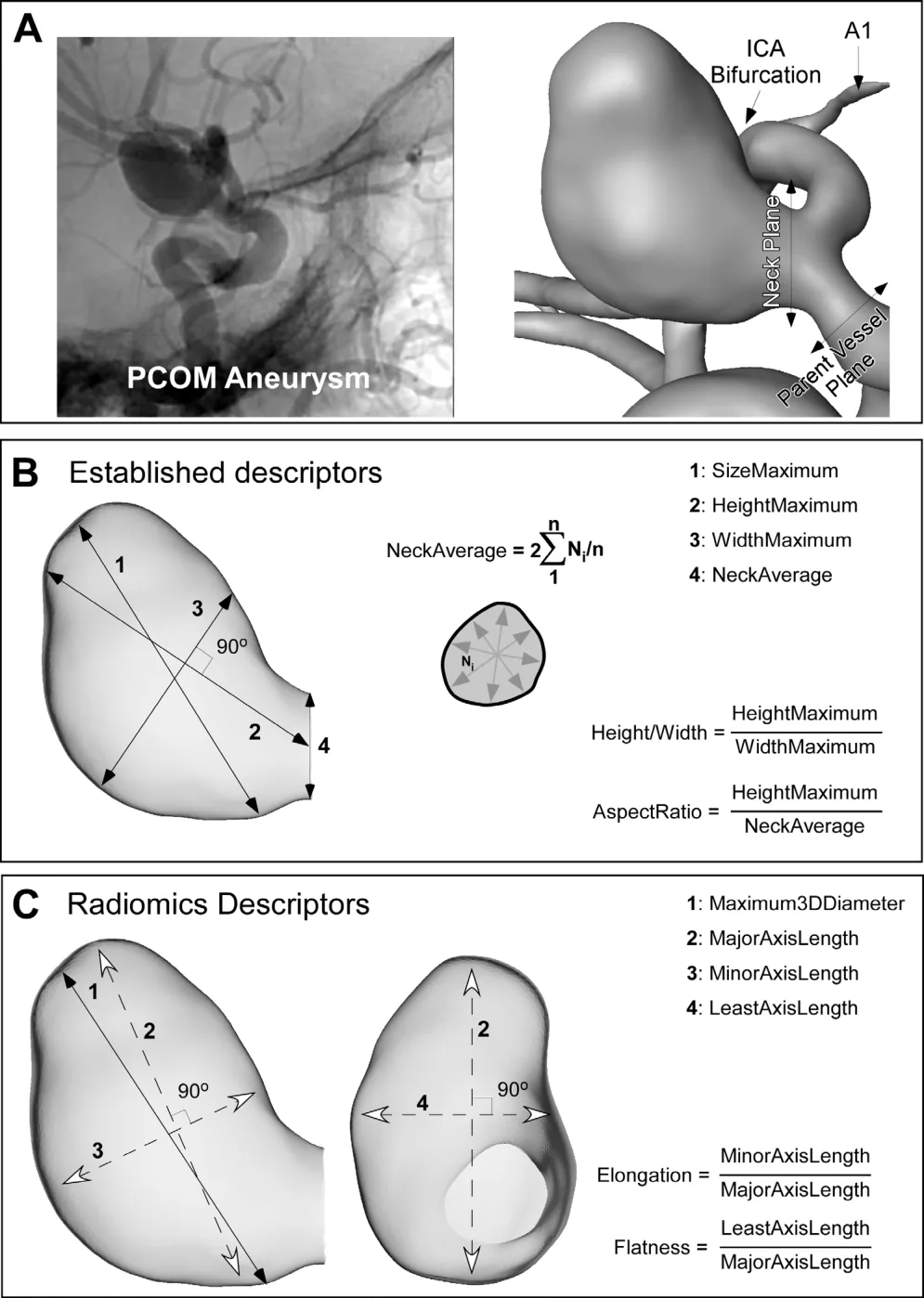
From angiograms of 353 aneurysms, 123 of them ruptured, the authors extracted 13 radiomics measurements and 13 established ones and compared how well each separated ruptured from unruptured aneurysms. Combining established measurements reached an area under the curve of 0.79, against 0.75 for the best radiomics combination (1.0 would be perfect). Several radiomics features overlapped closely with established ones.
Radiomics is automatic and free of operator judgment, but for now it discriminates less well.
A plain-language summary for patients and families. It is not medical advice, and individual results vary.
Abstract
Background
Morphological differences between ruptured and unruptured cerebral aneurysms represent a focus of neuroimaging researchfor understanding the mechanisms of aneurysmal rupture. We evaluated the performance of Radiomics derived morphological features, recently proposed for rupture status classification, against automatically measured shape and size features previously established in the literature.
Methods
353 aneurysms (123 ruptured) from three-dimensional rotational catheter angiography (3DRA) datasets were analyzed. Based on a literature review, 13 Radiomics and 13 established morphological descriptors were automatically extracted per aneurysm, and evaluated for rupture status prediction using univariate and multivariate statistical analysis, yielding an area under the curve (AUC) metric of the receiver operating characteristic.
Results
Validation of overlapping descriptors for size/volume using both methods were highly correlated (p<0.0001, R 2=0.99). Univariate analysis selected AspectRatio (p<0.0001, AUC=0.75), Non-sphericity Index (p<0.0001, AUC=0.75), Height/Width (p<0.0001, AUC=0.73), and SizeRatio (p<0.0001, AUC=0.73) as best among established descriptors, and Elongation (p<0.0001, AUC=0.71) and Flatness (p<0.0001, AUC=0.72) among Radiomics features. Radiomics Elongation correlated best with established Height/Width (R 2=0.52), whereas Radiomics Flatness correlated best with Ellipticity Index (R 2=0.54). Radiomics Sphericity correlated best with Undulation Index (R 2=0.65). Best Radiomics performers, Elongation and Flatness, were highly correlated descriptors (p<0.0001, R 2=0.75). In multivariate analysis, established descriptors (Height/Width, SizeRatio, Ellipticity Index; AUC=0.79) outperformed Radiomics features (Elongation, Maximum3Ddiameter; AUC=0.75).
Conclusion
Although recently introduced Radiomics analysis for aneurysm shape and size evaluation has the advantage of being an efficient operator independent methodology, it currently offers inferior rupture status discriminant performance compared with established descriptors. Future research is needed to extend the current Radiomics feature set to better capture aneurysm shape information.
Abstract as indexed in PubMed (PMID 33158993). Copyright the publisher.
Cite this paper
Ludwig CG, Lauric A, Malek JA, Mulligan R, Malek AM. Performance of Radiomics derived morphological features for prediction of aneurysm rupture status. J Neurointerv Surg 13(8):755-761. 2021. doi:10.1136/neurintsurg-2020-016808 PMID: 33158993.