2012 · Hemodynamics & imaging
Incremental contribution of size ratio as a discriminant for rupture status in cerebral aneurysms: comparison with size, height, and vessel diameter
Lauric A, Baharoglu MI, Gao BL, Malek AM.
Neurosurgery 70(4):944-51; discussion 951-2, 2012.
PMID 21997542 · DOI 10.1227/NEU.0b013e31823bcda7
In plain language
Size ratio, the size of an aneurysm divided by the width of the artery it grows from, has been proposed as a way to tell ruptured from unruptured brain aneurysms. This study tested how much it adds beyond simpler measures, using detailed 3D angiography images of 267 aneurysms, 98 of them ruptured.
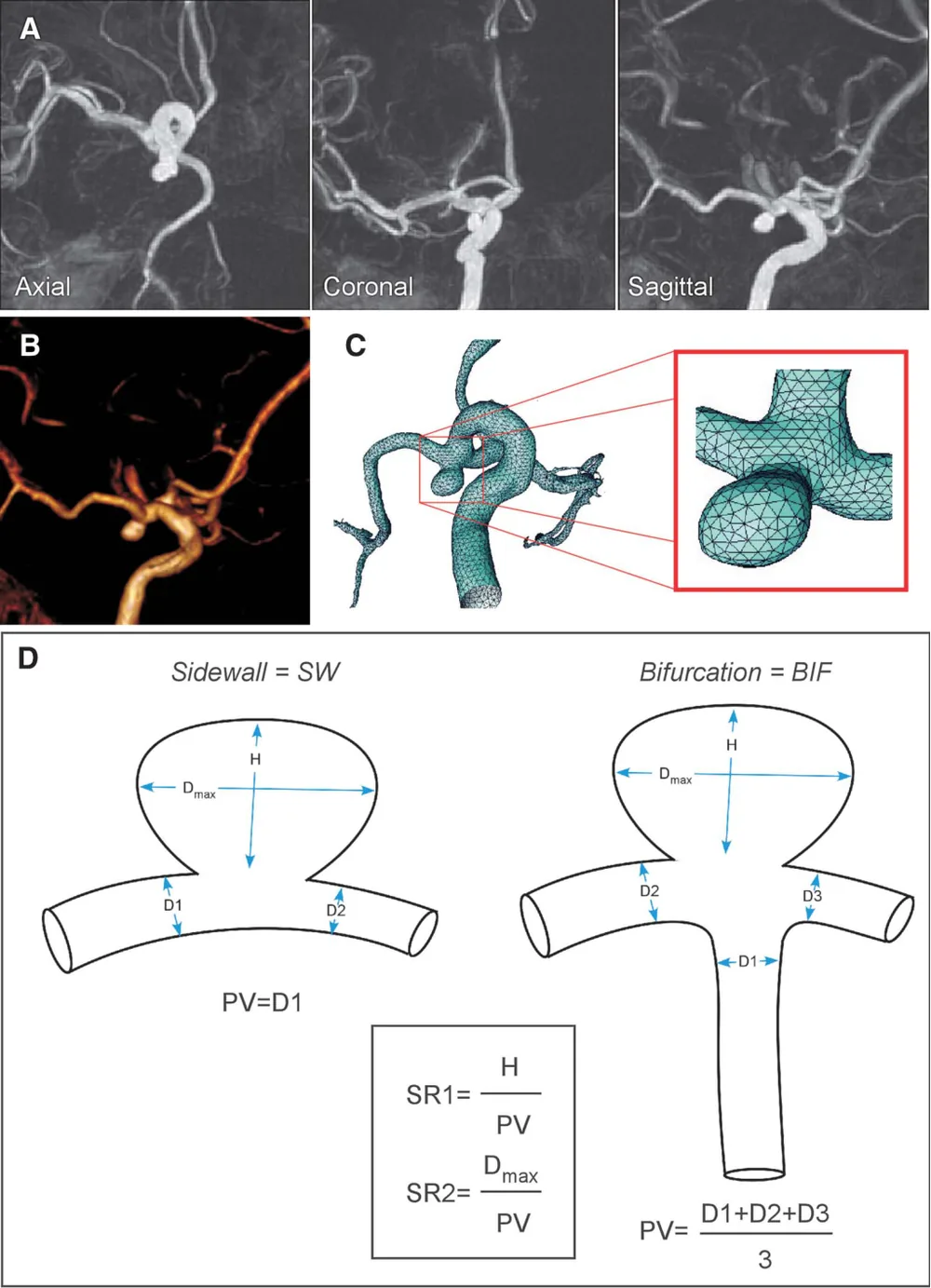
Size ratio did not help for bifurcation aneurysms, those at branch points. For sidewall aneurysms it performed well, with areas under the curve of 0.84 and 0.78 for two versions (1.0 would be perfect), but no better than aneurysm height or maximum size alone.
The authors suggest that earlier positive reports may reflect which aneurysm types were studied.
A plain-language summary for patients and families. It is not medical advice, and individual results vary.
Abstract
Background
Aneurysm size ratio (SR), variably defined as the ratio of dome height (H) or maximal dimension (D(max)) over average parent vessel diameter (PV) diameter, has been proposed as a promising aneurysm rupture status predictor.
Objective
To evaluate the incremental contribution of SR to retrospective rupture status determination in a large high-resolution aneurysm database.
Methods
Measurements were performed on catheter 3D-rotational angiographic volumetric datasets for 267 aneurysms (98 ruptured). SR was computed both as H/PV (SR1) and as D(max)/PV (SR2), and its discriminant performance was evaluated on the whole dataset, on aneurysm-type subsets (bifurcation [BIF] vs sidewall [SW]), and at specific aneurysm locations. Univariate and multivariate statistical analyses were performed by the use of area under the curve (AUC) of the receiver-operating characteristics.
Results
Neither SR1 nor SR2 were statistically correlated to rupture status in the BIF group, where only PV (AUC = 0.61) achieved significance. All parameters were statistically significant in the combined group, but with modest performance (AUC range, 0.62-0.74). SR1 (AUC = 0.84) and SR2 (AUC = 0.78) were strong predictors in the SW group, similar to H (AUC = 0.83) and D(max) (AUC = 0.77). Multivariate statistics failed to support SR as an incremental independent parameter from PV, D(max), and H.
Conclusion
SR provides an uneven performance that depends strongly on the BIF/SW distribution of the data and is not useful for bifurcation lesions. In the SW subset, the incremental contribution of the SR over its H or D(max) individual component measurements could not be validated, suggesting prior findings of its utility to be the result of aneurysm-type selection bias.
Abstract as indexed in PubMed (PMID 21997542). Copyright the publisher.
Cite this paper
Lauric A, Baharoglu MI, Gao BL, Malek AM. Incremental contribution of size ratio as a discriminant for rupture status in cerebral aneurysms: comparison with size, height, and vessel diameter. Neurosurgery 70(4):944-51; discussion 951-2. 2012. doi:10.1227/NEU.0b013e31823bcda7 PMID: 21997542.