2022 · Hemodynamics & imaging
Vortex formation and associated aneurysmogenic transverse rotational shear stress near the apex of wide-angle cerebral bifurcations
Malek AM, Hippelheuser JE, Lauric A.
J Neurosurg 136(6):1726-1737, 2022.
PMID 34715656 · DOI 10.3171/2021.6.JNS204385
In plain language
Aneurysms, weak bulges in an artery wall, tend to form where a brain artery splits into two at a wide angle. Earlier work showed that such wide splits expose the wall to a rising rubbing force from flowing blood, called wall shear stress. This study looked for other parts of the flow pattern that change as the angle widens.
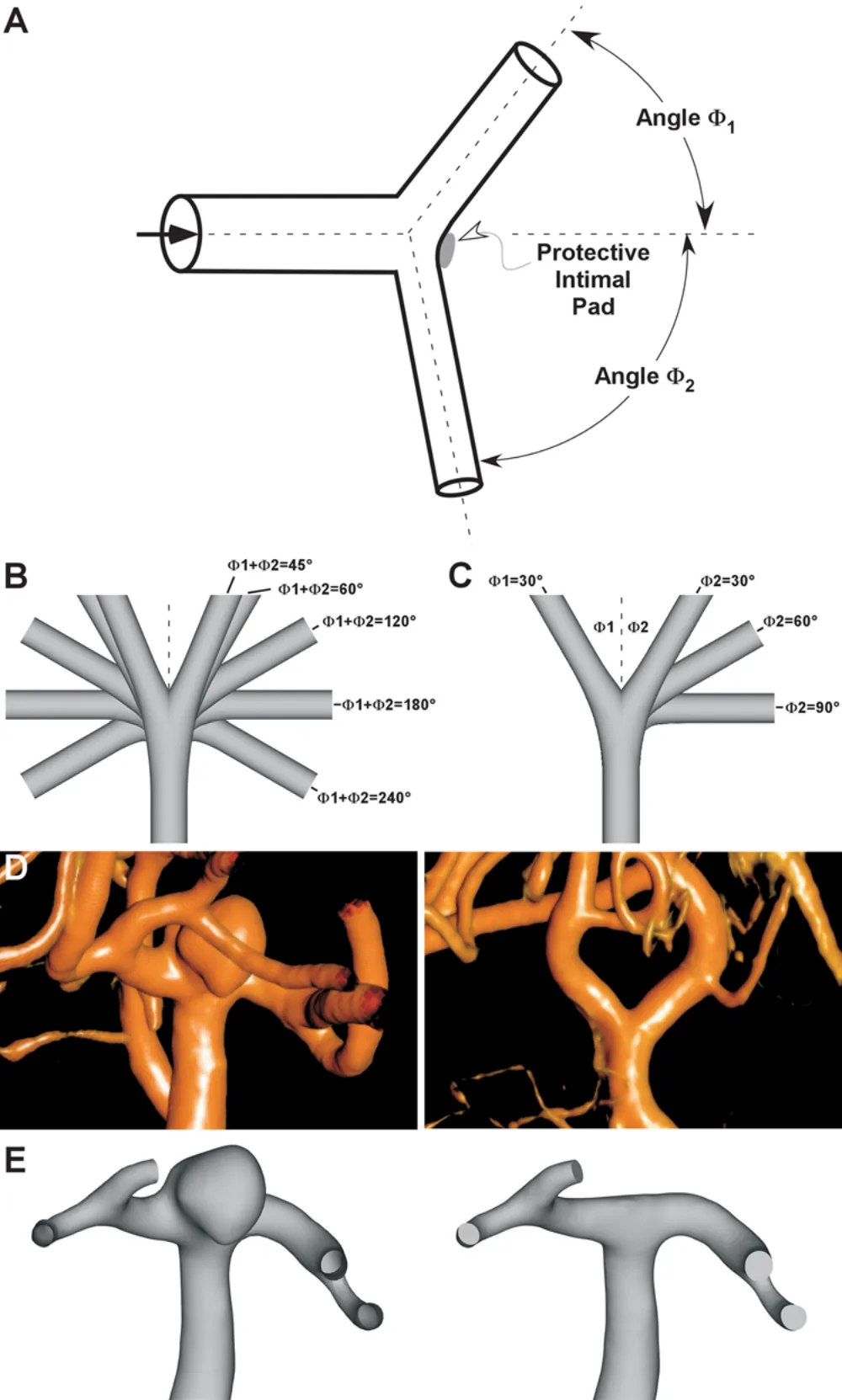
Using computer simulations of blood flow in idealized models with angles from 45 to 240 degrees, and in 13 real middle cerebral artery splits (7 with aneurysms, 6 without), the authors found that wider angles create a swirling vortex. This produces a sideways, rotating wall force that stays high far downstream in wide splits but fades quickly in narrow ones. Aneurysm sites had wider angles and higher values of this force.
This newly described force may help explain why aneurysms form at wide bifurcations.
A plain-language summary for patients and families. It is not medical advice, and individual results vary.
Abstract
Objective
Aneurysm formation preferentially occurs at the site of wide-angle cerebral arterial bifurcations, which were recently shown to have a high longitudinal positive wall shear stress (WSS) gradient that promotes aneurysm formation. The authors sought to explore the other components of the hemodynamic environment that are altered with increasing bifurcation angle in the apical region and the effects of these components on WSS patterns on the vessel wall that may modulate aneurysm genesis and progression.
Methods
Parametric models of symmetrical and asymmetrical bifurcations were created with increasing bifurcation angles (45°-240°), and 3D rotational angiography models of 13 middle cerebral artery (MCA) bifurcations (7 aneurysmal, 6 controls) were analyzed using computational fluid dynamics. For aneurysmal bifurcations, the aneurysm was digitally removed to uncover hemodynamics at the apex. WSS vectors along cross-sectional planes distal to the bifurcation apex were decomposed as orthogonal projections to the cut plane into longitudinal and transverse (tangential to the cross-sectional plane) components. Transverse rotational WSS (TRWSS) and TRWSS gradients (TRWSSGs) were sampled and evaluated at the apex and immediately distal from the apex.
Results
In parametric models, increased bifurcation angle was associated with transverse flow vortex formation with emergence of an associated apical high TRWSS with highly aneurysmogenic positive TRWSSGs. While TRWSS decayed rapidly away from the apex in narrow-angle bifurcations, it remained greatly elevated for many radii downstream in aneurysm-prone wider bifurcations. In asymmetrical bifurcations, TRWSS was higher on the aneurysm-prone daughter vessel associated with the wider angle. Patient-derived models with aneurysmal bifurcations had wider angles (149.33° ± 12.56° vs 98.17° ± 8.67°, p < 0.001), with significantly higher maximum TRWSS (1.37 ± 0.67 vs 0.48 ± 0.23 Pa, p = 0.01) and TRWSSG (1.78 ± 0.92 vs 0.76 ± 0.50 Pa/mm, p = 0.03) compared to control nonaneurysmal bifurcations.
Conclusions
Wider vascular bifurcations are associated with a novel and to the authors' knowledge previously undescribed transverse component rotational wall shear stress associated with a positive (aneurysmogenic) spatial gradient. The resulting hemodynamic insult, demonstrated in both parametric models and patient-based anatomy, is noted to decay rapidly away from the protection of the medial pad in healthy narrow-angle bifurcations but remain elevated distally downstream of wide-angle aneurysm-prone bifurcations. This TRWSS serves as a new contribution to the hemodynamic environment favoring aneurysm formation and progression at wide cerebral bifurcations and may have clinical implications favoring interventions that reduce bifurcation angle.
Abstract as indexed in PubMed (PMID 34715656). Copyright the publisher.
Cite this paper
Malek AM, Hippelheuser JE, Lauric A. Vortex formation and associated aneurysmogenic transverse rotational shear stress near the apex of wide-angle cerebral bifurcations. J Neurosurg 136(6):1726-1737. 2022. doi:10.3171/2021.6.JNS204385 PMID: 34715656.