2026 · Hemodynamics & imaging
A novel application of radiomics for the evaluation of transient wall shear stress on the surface of cerebral aneurysms
Lauric A, Malek AM.
J Clin Neurosci 145:111851, 2026.
PMID 41506072 · DOI 10.1016/j.jocn.2026.111851
In plain language
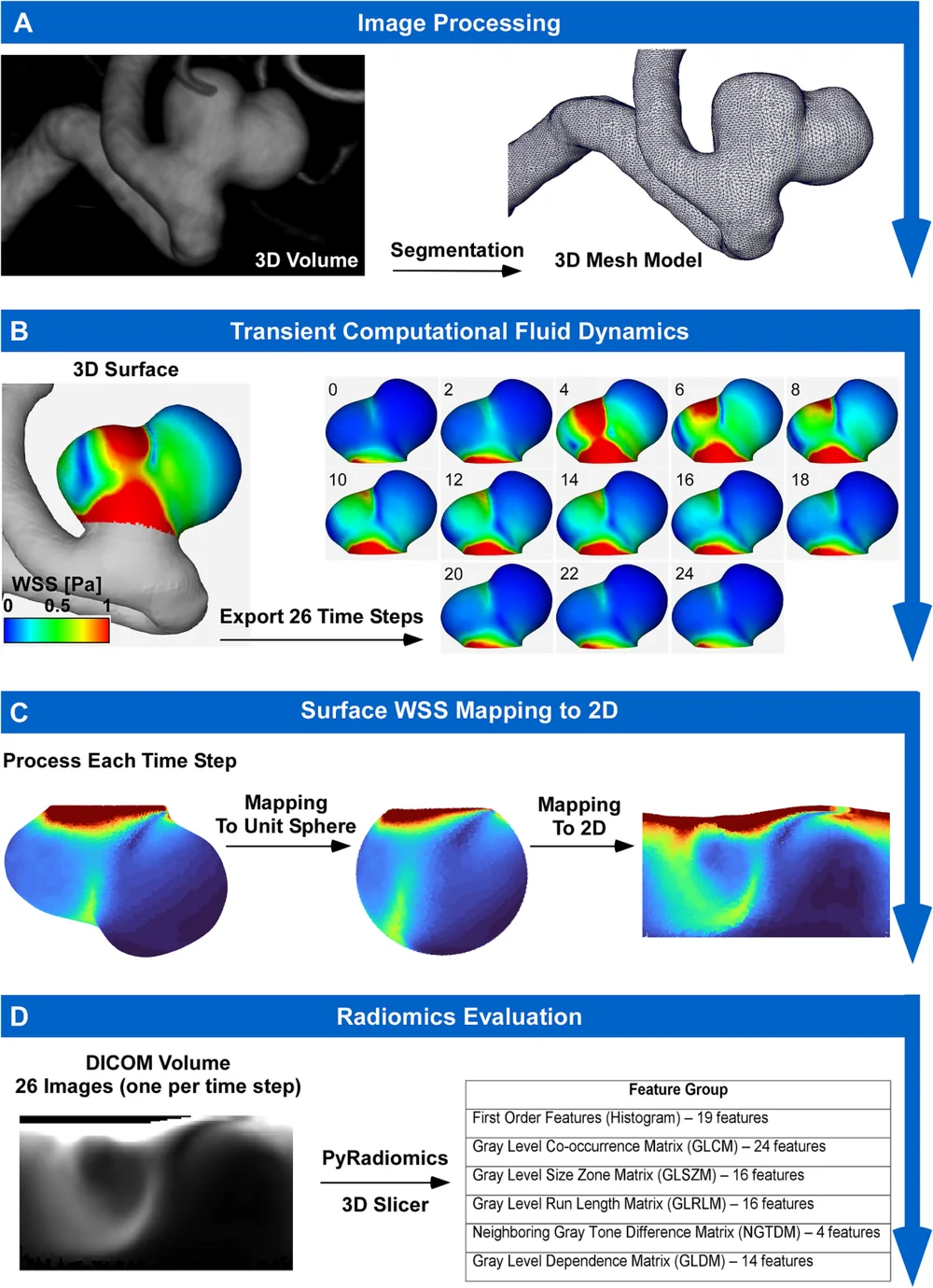
Blood flowing over the wall of an aneurysm creates a rubbing force called wall shear stress, which can be calculated with computer simulations of blood flow. This study borrowed radiomics, a method that analyzes texture and pattern in medical images, and applied it to maps of this force over a full heartbeat in 75 aneurysms, 33 of which had ruptured.
Ruptured aneurysms showed more irregular, patchy and complex force patterns than unruptured ones, and the method separated the two groups well, with an area under the curve of 0.81 (1.0 would be perfect).
This new approach could eventually help identify aneurysms that are more likely to burst.
A plain-language summary for patients and families. It is not medical advice, and individual results vary.
Abstract
Background
Intracranial aneurysm evaluation based on computational fluid dynamic (CFD) wall shear stress (WSS) analysis remains an active and evolving research field. We propose a novel application of radiomics for transient CFD, focusing on texture and pattern evaluation of aneurysmal WSS, beyond conventional distribution analysis.
Methods
Catheter 3D rotational angiographic volumes were available for 75 aneurysms (33 ruptured). Transient CFD simulations were performed on aneurysmal models across the cardiac cycle, exporting WSS distributions at 25 consecutive time steps. 3D WSS distributions were mapped to 2D by projection to unit sphere, followed by normalization and logarithmic transformation for analysis at extrema. The resulting 2D spatial WSS images over time formed 3D DICOM volumes for radiomics analysis. Uni- and multivariate analysis was used to evaluate radiomics features for rupture status discriminant performance.
Results
Compared to unruptured, ruptured aneurysms show increased complexity and heterogeneity in the spatial and temporal domains (higher DifferenceEntropy, JointAverage, JointEntropy), with distinct areas of low and high WSS-derived intensity (lower InverseDifference, higher SumAverage). Ruptured aneurysms showed significantly less uniformity of pattern both in size (higher SizeZoneNonUniformity) and intensity (higher GrayLevelNonUniformity). Multivariate analysis for rupture status discrimination resulted in an area under the curve (AUC) value of 0.81 (sensitivity 0.82, specificity 0.72).
Conclusion
Radiomics analysis of transient WSS resulted in strong rupture status discrimination. This novel approach extends the use of radiomics beyond angiographic analysis, enables evaluation of WSS evolution over the entire cardiac cycle, provides insights into rupture characteristics, and opens novel and promising avenues of future research.
Abstract as indexed in PubMed (PMID 41506072). Copyright the publisher.
Cite this paper
Lauric A, Malek AM. A novel application of radiomics for the evaluation of transient wall shear stress on the surface of cerebral aneurysms. J Clin Neurosci 145:111851. 2026. doi:10.1016/j.jocn.2026.111851 PMID: 41506072.