2014 · Devices & clinical
Use of concentric Solitaire stent to anchor Pipeline flow diverter constructs in treatment of shallow cervical carotid dissecting pseudoaneurysms
Rahal JP, Dandamudi VS, Heller RS, Safain MG, Malek AM.
J Clin Neurosci 21(6):1024-8, 2014.
PMID 24411325 · DOI 10.1016/j.jocn.2013.10.017
In plain language
A pseudoaneurysm is a bulge caused by a tear in an artery wall. The Pipeline device, a fine mesh flow-diverting stent, works well for many brain aneurysms, but in the neck it tends to slip and shorten because the artery moves with the head and widens again as it heals.
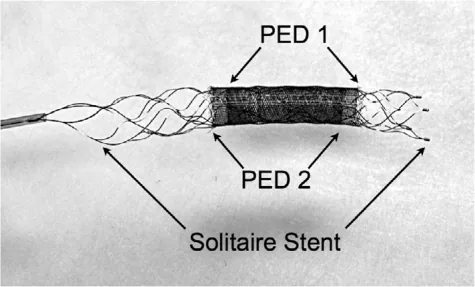
The authors describe a new technique in 2 patients with shallow, broad carotid pseudoaneurysms in the neck: overlapping Pipeline devices were placed across the defect and held in place by a Solitaire stent overlapping both ends as an anchor. As expected, the artery widened after the pseudoaneurysm clotted off and the Pipeline construct shifted and expanded slightly, but it stayed within the anchor, and the artery remained open with no leak at 3 and 5 months.
This approach may allow flow diverters to be used in mobile neck arteries.
A plain-language summary for patients and families. It is not medical advice, and individual results vary.
Abstract
The flow-diverting Pipeline Embolization Device (PED; ev3 Neurovascular, Irvine, CA, USA) provides proven flow diversion for intracranial wide-necked and fusiform aneurysms. The tendency of the PED to migrate and foreshorten when its size is mismatched with the parent vessel makes its use more difficult for cervical carotid pseudoaneurysms, as the parent vessel regains its luminal diameter during the healing phase, and because of its mobility during head movement. We present a novel technique of using a Solitaire detachable stent (ev3 Neurovascular) to anchor PED constructs to mitigate these shortcomings. Two patients with shallow and broad-necked cervical carotid pseudoaneurysms with underlying parent vessel stenosis deemed poor candidates for conventional stent-supported coiling were treated using tandem overlapping PED centered over the neck of the pseudoaneurysm and a Solitaire concentric anchor was deployed to overlap distally and proximally. As predicted, both patients revealed carotid luminal gain after aneurysm thrombosis with attendant migration (3.8 and 2.8mm) and expansion of the PED construct (14% and 7.8%) which remained constrained within the Solitaire anchoring device with persistent luminal patency and no evidence of endoleak at follow-up (3 and 5 months). The use of a concentric anchoring stent can mitigate the inherent tendency of the braided flow-diverting PED to migrate and foreshorten as the target vessel heals upon pseudoaneurysm thrombosis. This novel technique opens the possibility of using PED to treat shallow or fusiform lesions in mobile cervical arteries previously relegated to stent-supported coiling or surgical reconstruction.
Abstract as indexed in PubMed (PMID 24411325). Copyright the publisher.
Cite this paper
Rahal JP, Dandamudi VS, Heller RS, Safain MG, Malek AM. Use of concentric Solitaire stent to anchor Pipeline flow diverter constructs in treatment of shallow cervical carotid dissecting pseudoaneurysms. J Clin Neurosci 21(6):1024-8. 2014. doi:10.1016/j.jocn.2013.10.017 PMID: 24411325.