2011 · Devices & clinical
Endovascular recanalization of symptomatic flow-limiting cervical carotid dissection in an isolated hemisphere
Schirmer CM, Atalay B, Malek AM.
Neurosurg Focus 30(6):E16, 2011.
PMID 21631217 · DOI 10.3171/2011.2.FOCUS1139
In plain language
A dissection, a tear in the inner wall of the internal carotid artery in the neck, is a common cause of stroke in young people. This report describes 2 patients whose dissection nearly blocked the artery and whose affected brain hemisphere was isolated, meaning it had little backup blood supply from connecting arteries. Their symptoms worsened when blood pressure dropped.
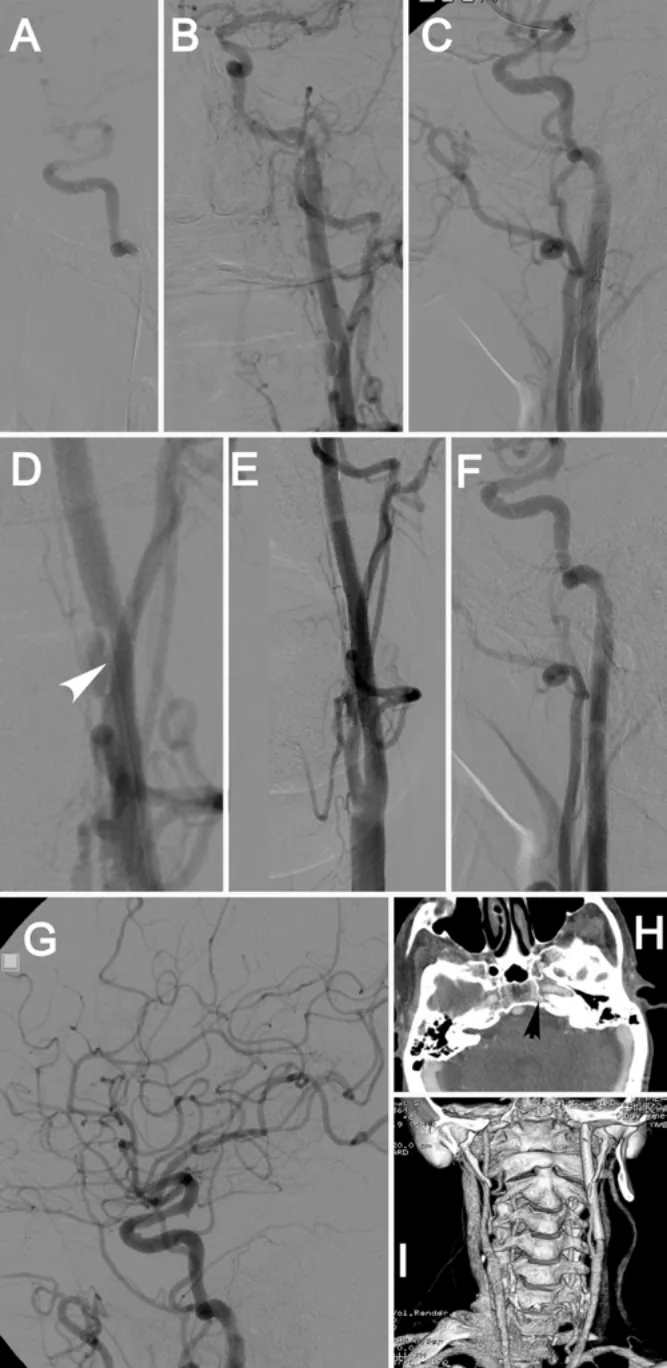
Doctors carefully guided a fine wire into the true channel of the artery and then placed overlapping stents to reopen it. Both patients improved and had no permanent neurological deficit.
The authors recommend stenting in such cases, where blood thinners alone may not be enough.
A plain-language summary for patients and families. It is not medical advice, and individual results vary.
Abstract
Object
Internal carotid artery dissection (ICAD) is a common cause of stroke in young patients, which may lead to major transient or permanent disability. Internal carotid artery dissection may occur spontaneously or after trauma and may present with a rapid neurological deterioration or with hemodynamic compromise and a delayed and unstable neurological deficit. Endovascular intervention using stent angioplasty can be used as an alternative to anticoagulation and open surgical therapy in this setting to restore blood flow through the affected carotid artery.
Methods
The authors present the cases of 2 patients with flow-limiting symptomatic ICAD leading to near-complete occlusion and without sufficient collateral supply. Both patients had isolated cerebral hemispheres without significant blood flow from the anterior or posterior communicating arteries. In both cases, the patients demonstrated blood pressure-dependent subacute unstable neurological deficits as a result of the hemodynamic compromise resulting from the dissection.
Results
Both patients underwent careful microwire-based selection of the true lumen followed by confirmatory microinjection and subsequent exchange-length microwire-based recanalization using tandem telescoping endovascular stenting. In both cases the neurological state improved, and no permanent neurological deficit ensued.
Conclusions
The treatment of ICAD may be difficult in patients with subacute unstable neurological deficits related to symptomatic hypoperfusion, especially in the setting of a hemodynamically isolated hemisphere. Anticoagulation alone may be insufficient in these patients. Although there is no widely accepted guideline for the treatment of ICAD, the authors recommend stent-mediated endovascular recanalization in cases of symptomatic flow-limiting hemodynamic compromise, especially in cases of an isolated hemisphere lacking sufficient communicating artery compensatory perfusion.
Abstract as indexed in PubMed (PMID 21631217). Copyright the publisher.
Cite this paper
Schirmer CM, Atalay B, Malek AM. Endovascular recanalization of symptomatic flow-limiting cervical carotid dissection in an isolated hemisphere. Neurosurg Focus 30(6):E16. 2011. doi:10.3171/2011.2.FOCUS1139 PMID: 21631217.