2012 · Hemodynamics & imaging
Patient based computational fluid dynamic characterization of carotid bifurcation stenosis before and after endovascular revascularization
Schirmer CM, Malek AM.
J Neurointerv Surg 4(6):448-54, 2012.
PMID 22039041 · DOI 10.1136/neurintsurg-2011-010070
In plain language
The forces of flowing blood on the artery wall shape how endothelial cells, the cells lining blood vessels, behave. This study used computer simulations of blood flow, built from 3D angiography images, to examine severe narrowing of the carotid artery in the neck in eight patients before and after carotid artery stenting.
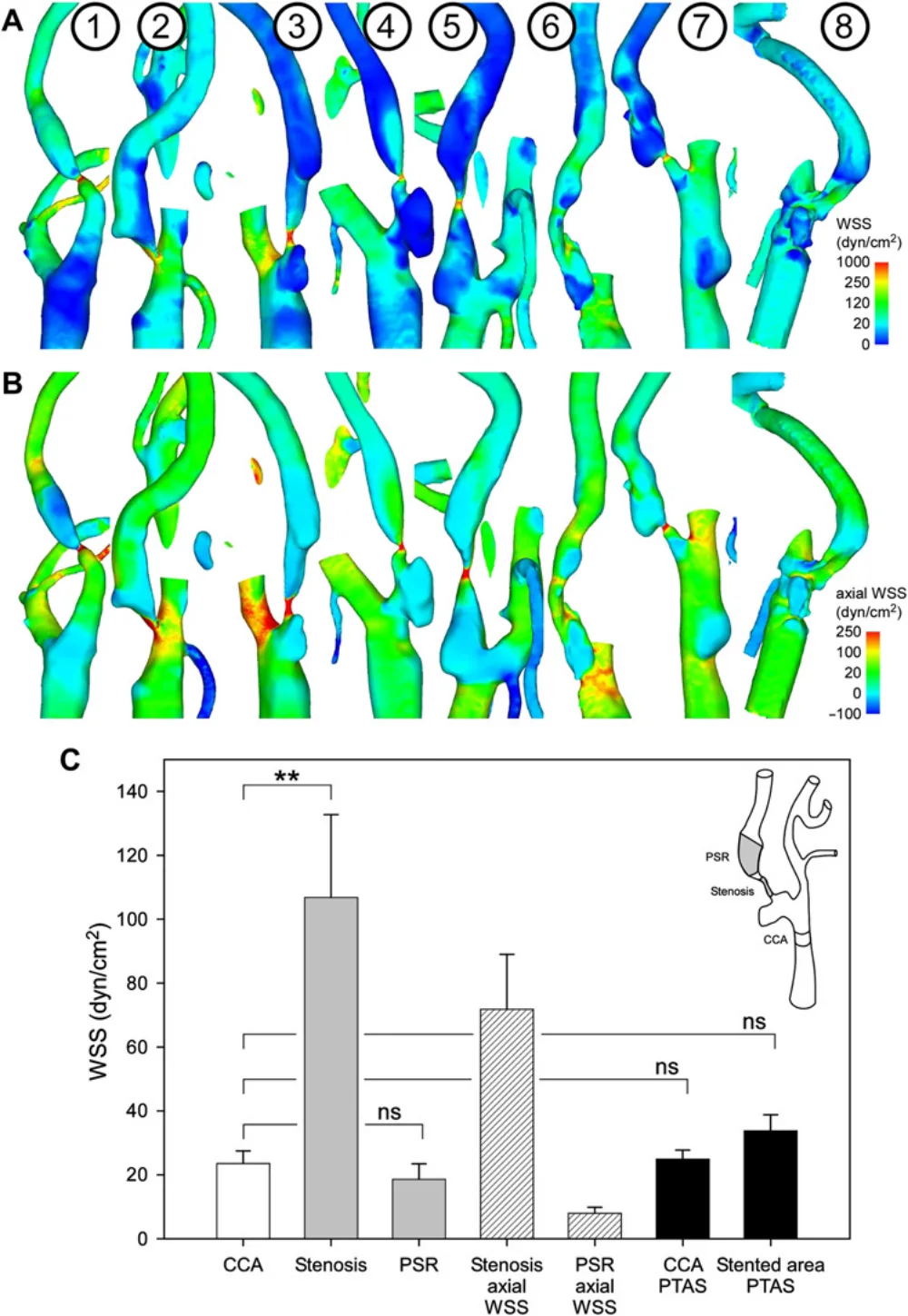
Stenting restored smooth or nearly smooth flow in all cases. Wall shear stress, the rubbing force of blood on the wall, fell to near normal levels in the stented region, averaging 34 dyn/cm², and the extreme changes in this force seen before treatment were greatly blunted.
Stenting thus reversed abnormal flow patterns known to be linked to unhealthy function of the vessel lining.
A plain-language summary for patients and families. It is not medical advice, and individual results vary.
Abstract
Introduction
Hemodynamic forces play a critical role in determining the molecular phenotype of the endothelial cell and in influencing vascular remodeling. A lesion based computational fluid dynamic (CFD) modeling approach is presented to understand the complex spatial and temporal hemodynamic changes that prevail in carotid stenosis (CS) in patients with critical CS undergoing carotid artery stenting (CAS).
Methods
High resolution three-dimensional rotational angiography volumetric datasets were acquired before and after treatment in eight patients, segmented and used to generate a high quality structured hexahedral computational mesh with boundary layer refinement. CFD analysis was carried out using a time dependent laminar flow model implementing non-Newtonian realistic blood viscosity for blood, and used to compute wall shear stress (WSS) and its gradient (WSSG).
Results
CAS restored fully or near laminar flow in all cases in our series. In addition, WSS was found to decrease in the stented region in all cases, reduced to near normal levels of 34±14 dyn/cm(2) with significant blunting of the extreme pretreatment WSSG to levels lower than 1000 dyn/cm(3).
Conclusions
In this series of patients with symptomatic CS, CFD simulation enabled estimation of the hemodynamic effect of CAS, leading to reversal of abnormal flow patterns and wall shear forces around the arterial stenosis, with normalization of flow laminarity and wall shear spatiotempotal patterns known to be associated with adverse endothelial cell function.
Abstract as indexed in PubMed (PMID 22039041). Copyright the publisher.
Cite this paper
Schirmer CM, Malek AM. Patient based computational fluid dynamic characterization of carotid bifurcation stenosis before and after endovascular revascularization. J Neurointerv Surg 4(6):448-54. 2012. doi:10.1136/neurintsurg-2011-010070 PMID: 22039041.