2022 · Hemodynamics & imaging
Moments of Intra-Dome Velocity Distribution as Robust Predictors of Rupture Status in Cerebral Aneurysms
Lauric A, Hippelheuser JE, Malek AM.
World Neurosurg 158:e334-e343, 2022.
PMID 34740832 · DOI 10.1016/j.wneu.2021.10.178
In plain language
Doctors would like better ways to tell which brain aneurysms are dangerous. A common approach uses wall shear stress, the rubbing force of blood on the vessel wall, but it is easily thrown off by small bumps and noise on the aneurysm surface.
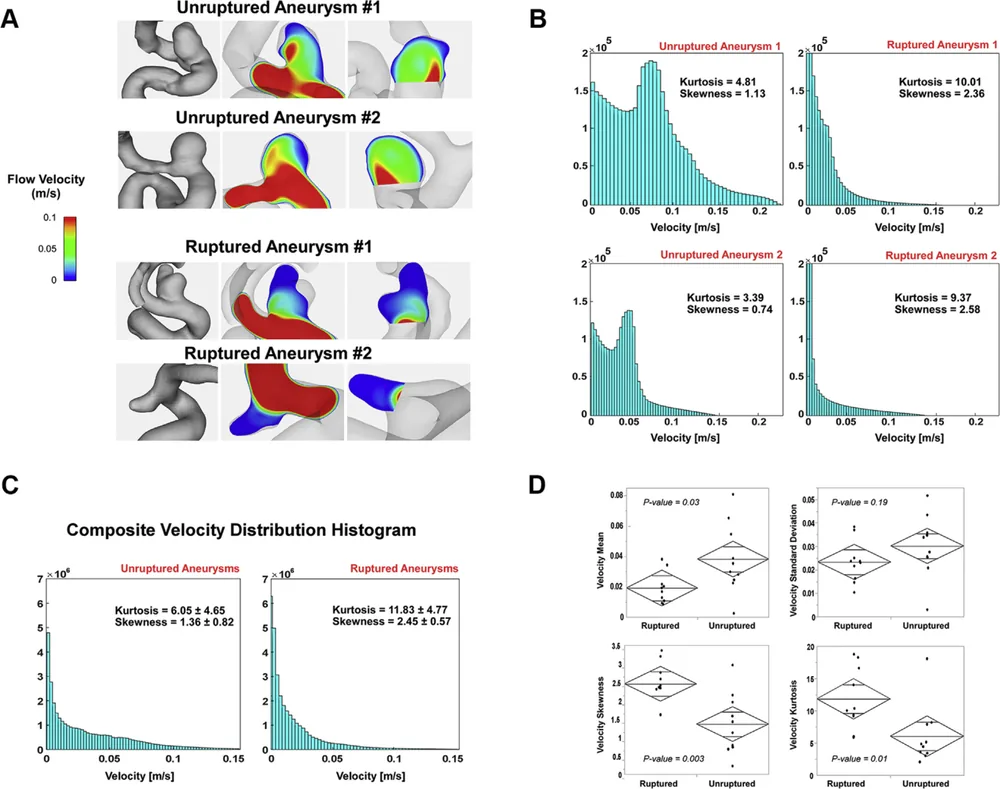
This study instead looked at how blood speed is spread throughout the inside of the aneurysm, using computer flow simulations in 20 aneurysms, 10 of which had ruptured. Ruptured aneurysms had more areas of slow flow, and one statistical measure of the speed pattern, called skewness, best separated ruptured from unruptured aneurysms, with an area under the curve of 0.88 (1.0 would be perfect). Unlike wall force, this measure changed very little when surface bumps were removed or noise was added.
The approach looks promising but needs testing in larger studies.
A plain-language summary for patients and families. It is not medical advice, and individual results vary.
Abstract
Background
Wall shear stress (WSS), the spatial gradient of flow velocity at luminal surface, has been employed for aneurysmal hemodynamic analysis, but it is sensitive to surface irregularities and noise. We devised a volumetric approach to evaluate discriminant power of intra-dome flow velocity distribution and modal analysis in rupture status determination compared with previously described WSS analysis.
Methods
Catheter three-dimensional rotational angiographic datasets matched for volume were segmented in 20 sidewall aneurysms (10 ruptured), computational fluid dynamics simulations were performed, and velocity distributions were extracted from mesh-independent isometric sampling followed by moment analysis (mean, variance, skewness, and kurtosis). Univariate and multivariate analysis was used to evaluate discriminant performance of velocity moments. Sensitivity of velocity moments and WSS was evaluated to bleb presence and surface irregularity using digital bleb removal and surface noise addition.
Results
Velocity moments of ruptured aneurysms showed higher skewness (2.45 ± 0.57 vs. 1.36 ± 0.82, P = 0.003) and kurtosis (11.83 ± 4.77 vs. 6.05 ± 4.65, P = 0.01) with lower mean (0.019 ± 0.01 vs. 0.038 ± 0.02, P = 0.03) compared with unruptured lesions; in multivariate modeling, skewness alone emerged as best predictor (area under the curve = 0.88). Bleb removal increased low WSS by 548%, and surface noise decreased it by 85.8% while having a smaller (<7%) effect on velocity skewness and kurtosis.
Conclusions
High aneurysm dome flow velocity skewness and kurtosis suggest an exponential distribution in ruptured lesions, with high peaks at low velocities, consistent with areas of slow flow. In contrast to WSS-based techniques, this approach is robust against surface variations, with promising improved rupture status discriminant performance that requires further validation in expanded future studies.
Abstract as indexed in PubMed (PMID 34740832). Copyright the publisher.
Cite this paper
Lauric A, Hippelheuser JE, Malek AM. Moments of Intra-Dome Velocity Distribution as Robust Predictors of Rupture Status in Cerebral Aneurysms. World Neurosurg 158:e334-e343. 2022. doi:10.1016/j.wneu.2021.10.178 PMID: 34740832.