2025 · Devices & clinical
Macrowire-only direct aspiration first-pass technique for endovascular mechanical thrombectomy: Multicenter technical series using the 0.035″ aristotle Colossus wire
Ares W, Tonetti D, Koneru M, Dalkilic A, Salah W, Brinjikji W, Rajjoub K, Raz E, Khawaja A, Southwood C, Dalyai R, Birnbaum L, Chowdhry S, Do H, Joyce E, Calnan D, Malek A, Grandhi R.
Interv Neuroradiol, 2025.
PMID 40400317 · DOI 10.1177/15910199251343117 · PMCID PMC12098323
In plain language
In stroke caused by a blocked brain artery, doctors often remove the clot with suction through a large catheter. Guiding that catheter to the clot usually requires additional smaller tubes or devices. This study tested whether a single thicker guidewire, the Aristotle Colossus "macrowire," could do the job alone.
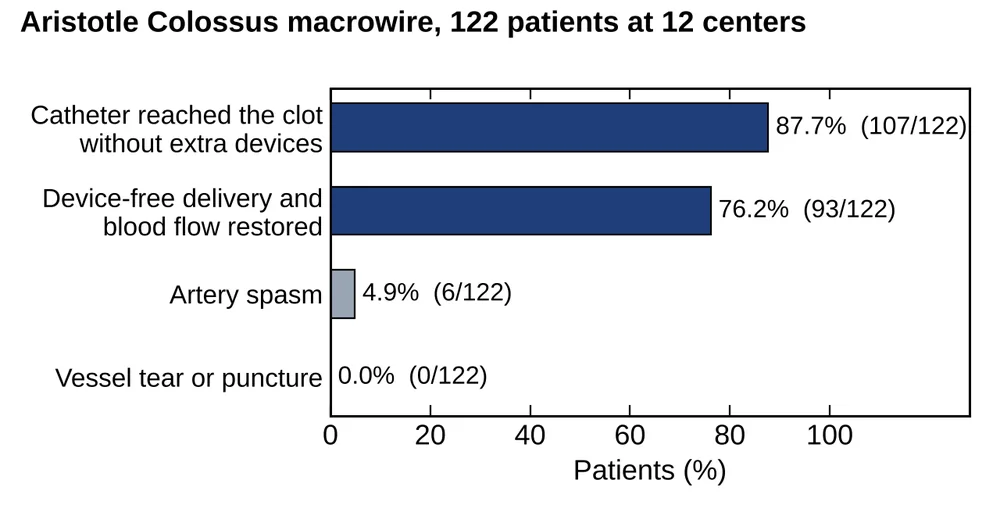
Across 12 institutions, 122 patients with blockages in the front part of the brain circulation were reviewed. The catheter reached the clot without extra devices in 87.7%, and 76.2% had both device-free delivery and successful restoration of blood flow. A very twisted carotid artery or a buildup of fatty plaque in brain arteries made success less likely. Artery spasm occurred in 4.9%, with no tears or punctures of vessels.
The guidewire appeared to safely simplify this stroke procedure.
A plain-language summary for patients and families. It is not medical advice, and individual results vary.
Abstract
BackgroundLarger "macrowires" may facilitate microcatheter-free delivery of large-bore aspiration catheters (ACs) for intracranial endovascular mechanical thrombectomy. We examined the safety and efficacy of the Aristotle Colossus Guidewire for this use.MethodsIn this retrospective analysis of prospective data from 12 institutions, we identified anterior circulation endovascular mechanical thrombectomy cases involving the Aristotle Colossus guidewire over a 12-month period. The primary efficacy endpoint was successful delivery of the AC to the site without the use of adjunct devices. Multivariable logistic regression was performed with clinically relevant covariables.ResultsIn 122 patients (median age 74 years (interquartile range (IQR) 63-82)), most intracranial occlusions were in the M1 segment of the middle cerebral artery (95/122, 78.0%). The primary endpoint of microcatheter-free AC delivery was met in 87.7% (107/122) of patients; 93/122 (76.2%) patients underwent microcatheter-free delivery with successful reperfusion via contact aspiration (modified thrombolysis in cerebral infarction grade ≥ 2B). The median number of passes was 1 (IQR 1-2). Multivariable regression demonstrated that severe internal carotid artery tortuosity or cervical loop presence (odds ratio (OR): 0.09, 95% confidence interval (CI): 0.01-0.54, p = 0.01) and presence of intracranial atherosclerotic disease (OR: 0.15, 95% CI: 0.03-0.83, p = 0.03) were significantly associated with lower odds of successful AC delivery over the guidewire. Intraprocedural vasospasm occurred in 4.9% (6/122) of cases; there were no reports of vessel dissection or perforation.ConclusionsWe demonstrate the favorable performance of the Aristotle Colossus guidewire for anterior circulation ischemic stroke intervention. The macrowire appears to safely facilitate navigation of the neurovasculature by large-bore ACs without the need for microcatheter and/or stentriever.
Abstract as indexed in PubMed (PMID 40400317). Copyright the publisher.
Cite this paper
Ares W, Tonetti D, Koneru M, Dalkilic A, Salah W, Brinjikji W, Rajjoub K, Raz E, Khawaja A, Southwood C, Dalyai R, Birnbaum L, Chowdhry S, Do H, Joyce E, Calnan D, Malek A, Grandhi R. Macrowire-only direct aspiration first-pass technique for endovascular mechanical thrombectomy: Multicenter technical series using the 0.035″ aristotle Colossus wire. Interv Neuroradiol. 2025. doi:10.1177/15910199251343117 PMID: 40400317.