2026 · Devices & clinical
The impact of stent length on stent-adjacent stenosis following transverse sinus stenting in idiopathic intracranial hypertension
Vajipayajula DN, Schreiner G, Snyder MH, Yu AJ, Burke SM, Ferraro TJ, Malek AM.
Neurosurg Focus 60(1):E12, 2026.
PMID 41569753 · DOI 10.3171/2025.10.FOCUS25865 · PMCID PMC13729911
Narrated summary
Figures © AANS, reproduced by the authors. Single-center, retrospective study.
Read the transcript
Our team at Tufts Medical Center asked a simple question: does the length of a stent in the brain's veins matter? I'm Adel Malek. Idiopathic intracranial hypertension, or IIH, is a condition in which the pressure of the fluid around the brain is too high. It causes headaches and a pulsing sound in the ears, and it can threaten vision. Many patients have a narrowing of the transverse sinus, a large vein that drains blood from the brain.
When medicines don't help, the narrowing can be opened with a stent, a small metal mesh tube placed from inside the vein. Early on, we used shorter stents that covered only the narrowed spot, to leave as little metal behind as possible. But over time, we saw a new problem. A fresh narrowing could form just beyond the end of the stent. We call it stent-adjacent stenosis. It can bring back symptoms and raise the pressure again.
So we moved to full-length stents, 80 millimeters long, that span the whole sinus. We reviewed 60 patients treated at Tufts over ten years. Sixteen received shorter stents, 40 or 60 millimeters long, and 44 received full-length stents. Stent-adjacent stenosis developed in 6 of the 16 patients with shorter stents, but in only 2 of the 44 with full-length stents. Three patients with shorter stents needed a second, overlapping stent.
Full-length stents also kept the pressure down better. Right after stenting, the pressure difference across the sinus fell in every patient. At follow-up, it stayed lower with full-length stents. Some symptoms persisted in about half of patients, similarly in both groups. Why does this happen? High pressure around the brain can squeeze the soft, unstented part of the sinus, so it collapses right at the stent's edge. Covering the whole sinus, from the sigmoid sinus to the torcula, removes that weak spot.
The takeaway: full-length stents greatly reduce stent-adjacent stenosis and keep venous pressures lower. They are now our standard for venous sinus stenting in IIH.
In plain language
In idiopathic intracranial hypertension, high pressure around the brain is often linked to a narrowing in a large vein at the back of the head, and a stent can open it. Early on, Tufts used short stents that covered only the narrowed spot, but some patients later developed a new narrowing right at the edge of the stent.
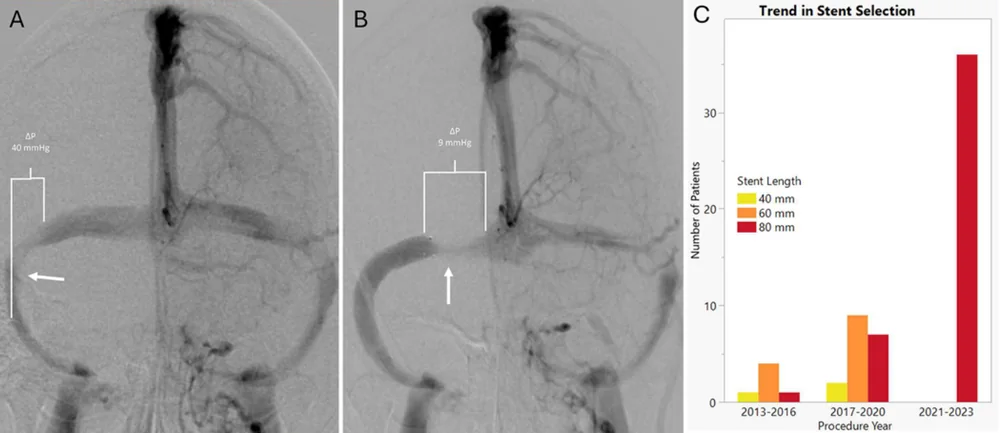
This study of 60 patients treated over ten years found that edge narrowing occurred in 6 of 16 patients with shorter stents, but in only 2 of 44 patients with full-length 80-millimeter stents. Full-length stents also lowered the pressure difference across the vein more. About half of patients in both groups still had some symptoms after an average of three years.
The authors now favor stents that span the entire vein segment.
A plain-language summary for patients and families. It is not medical advice, and individual results vary.
Abstract
Objective
Cerebral venous sinus stenting (VSS) is an established treatment for transverse sinus (TS) stenosis associated with idiopathic intracranial hypertension (IIH). The authors' early practice favored shorter stents that only spanned the focal narrowing to reduce the metal burden. However, stent-adjacent stenosis (SAS) emerged as a significant failure mode prompting the use of longer constructs. In this study, the authors sought to compare the incidence of SAS, clinical outcomes, and angiographic findings between shorter and full-length stent constructs.
Methods
The authors conducted a retrospective analysis of patients with IIH who underwent TS stenting at Tufts Medical Center in the period from 2013 to 2023. Patients with medically refractory IIH symptoms and a significant cerebral venous pressure gradient were included. Symptom presentation, neuroimaging, venous manometry, preoperative and follow-up angiography, and clinical examination findings were recorded and analyzed across two categories of stent length: shorter (40 or 60 mm) and full length (80 mm). SAS was defined as de novo narrowing of the TS contiguous with the stent edge.
Results
Endovascular treatment was successful in all 60 patients included in the study (48 females, mean patient age of 39 years). Three patients were treated with 40-mm stents, 13 with 60-mm stents, and 44 with full-length 80-mm stents. SAS was documented in 8 patients (13%) and was significantly more frequent (p < 0.01) among those with shorter stents (6/16), with 3 patients requiring reintervention using a second overlapping stent. Among the 44 patients with full-length constructs, 2 demonstrated SAS at the residual unstented TS lateral to the torcular Herophili. After a mean follow-up of 40 months, 29 patients (48%) reported persistent symptoms, although there was no significant difference in this rate between the stent groups. Full-length constructs demonstrated a more favorable postoperative reduction in TS pressure gradients (p < 0.01) and lower gradients on follow-up (p < 0.05).
Conclusions
SAS is a clinically relevant complication following VSS in patients with IIH and may contribute to persistent symptoms and the need for reintervention. Full-length stent constructs extending from the sigmoid sinus to the torcula significantly reduce the incidence of SAS and are associated with better hemodynamic outcomes following VSS.
Abstract as indexed in PubMed (PMID 41569753). Copyright the publisher.
Cite this paper
Vajipayajula DN, Schreiner G, Snyder MH, Yu AJ, Burke SM, Ferraro TJ, Malek AM. The impact of stent length on stent-adjacent stenosis following transverse sinus stenting in idiopathic intracranial hypertension. Neurosurg Focus 60(1):E12. 2026. doi:10.3171/2025.10.FOCUS25865 PMID: 41569753.