2026 · Devices & clinical
Endovascular shunt feasibility in shunt responsive idiopathic intracranial hypertension: morphometric radiographic analysis
Koo AB, Talati KV, Vajipayajula D, Castaneda A, Amllay A, Sujijantarat N, Kirsch C, Malhotra A, Hebert R, Falcone GJ, Sheth KN, de Havenon A, Kan P, Heilman CB, Malek AM, Matouk C.
J Neurointerv Surg, 2026.
PMID 41611529 · DOI 10.1136/jnis-2025-024793
In plain language
The eShunt drains excess spinal fluid through a tiny implant placed via a vein. It is not yet approved for idiopathic intracranial hypertension (IIH), and it was not known how many patients with IIH have anatomy that would fit it.
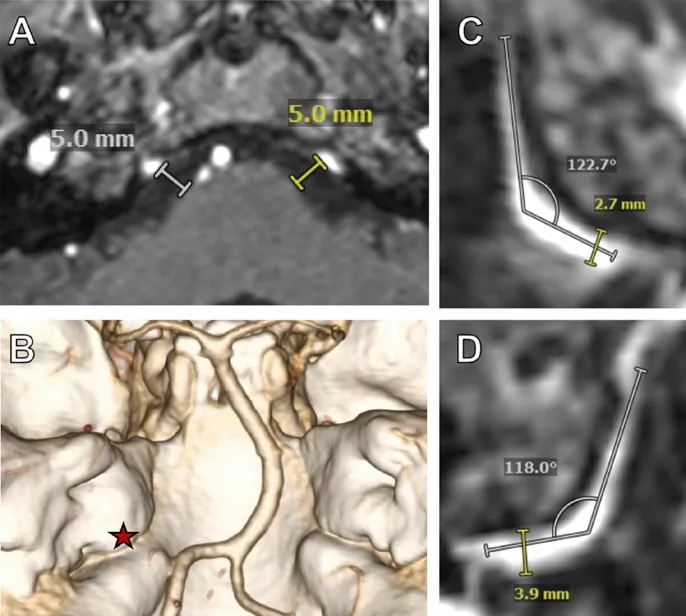
Researchers at Yale and Tufts measured the relevant veins and fluid spaces on the MRI scans of 53 patients with IIH who had needed a conventional shunt. At least one side was suitable in 55% of patients, rising to 74% when only the veins were considered. Having a brain shunt already in place did not reduce a patient's chances of being a candidate.
A plain-language summary for patients and families. It is not medical advice, and individual results vary.
Abstract
Background
Patients with idiopathic intracranial hypertension (IIH) represent a unique population in whom mechanical shunting can be challenging. Endovascular cerebrospinal fluid shunting via the eShunt system has emerged as a potential alternative, but it is not currently approved for this indication, and its feasibility in IIH remains unknown.
Methods
In this retrospective, single center study, radiographic images of consecutively treated patients with shunt responsive IIH were assessed. Radiographic parameters involving the inferior petrosal sinus (IPS) and cerebellopontine angle (CPA) cistern were measured. We also examined whether the presence of a ventricular shunt at the time of imaging influenced radiographic candidacy, given the plausibility of cisternal changes after shunting.
Results
Of 53 patients (median age 41 years, 81.1% women), 24 (45.2%) were previously shunted before MRI imaging. The average CPA cisternal depth was 4.8±1.8 mm (right) and 4.9±2.1 mm (left); IPS size 3.5±0.7 mm (right) and 3.4±0.8 mm (left). The average off-axis angle trajectory from the IPS to the cistern was 128.6±9.8° (right) and 125.2±9.3° (left). In our final model, pre-existing ventricular shunt was not independently associated with endovascular shunting candidacy (OR 2.01, 95% CI 0.65 to 6.40; P=0.227). Overall, endovascular shunting was feasible in at least one side for 55% of patients, increasing to as high as 74% when assessment was based only on venous anatomy.
Conclusion
In this study, a sizeable proportion of patients with IIH were radiographic candidates for endovascular shunting, regardless of the presence of a pre-existing supratentorial shunt.
Abstract as indexed in PubMed (PMID 41611529). Copyright the publisher.
Cite this paper
Koo AB, Talati KV, Vajipayajula D, Castaneda A, Amllay A, Sujijantarat N, Kirsch C, Malhotra A, Hebert R, Falcone GJ, Sheth KN, de Havenon A, Kan P, Heilman CB, Malek AM, Matouk C. Endovascular shunt feasibility in shunt responsive idiopathic intracranial hypertension: morphometric radiographic analysis. J Neurointerv Surg. 2026. doi:10.1136/jnis-2025-024793 PMID: 41611529.