2006 · Devices & clinical
Electrocautery-induced ignition of spark showers and self-sustained combustion of onyx ethylene-vinyl alcohol copolymer
Schirmer CM, Zerris V, Malek AM.
Neurosurgery 59(4 Suppl 2):ONS413-8, 2006.
PMID 17041511 · DOI 10.1227/01.NEU.0000240683.15391.99
In plain language
Onyx is a liquid material injected into abnormal blood vessels to block them off. It contains fine tantalum metal powder so that it can be seen on X-ray. Electrocautery, a surgical tool that uses electric current to cut tissue and stop bleeding, is commonly used during surgery.
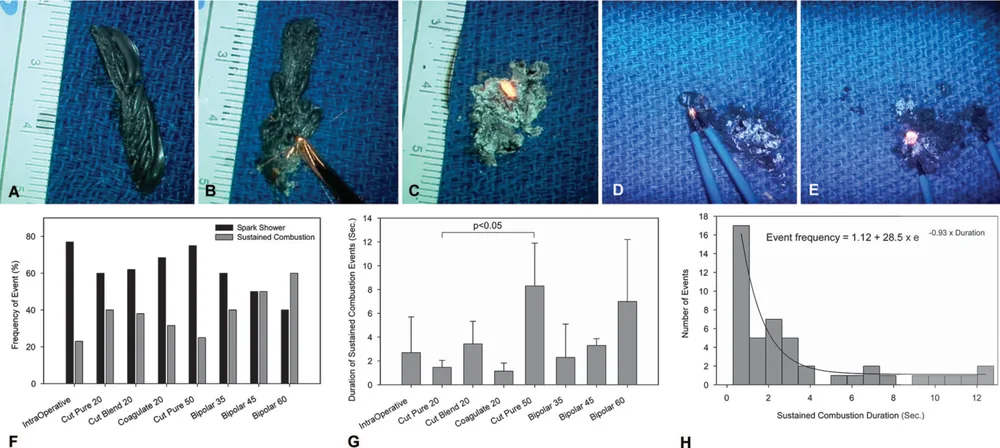
During one operation, using monopolar electrocautery on an artery filled with Onyx produced a shower of sparks and burning that continued on its own. Sparks spread more than 10 cm, and burning lasted a median of 1.65 seconds. In laboratory tests, the authors reproduced this with Onyx and with tantalum powder alone, but not with Onyx lacking tantalum or with a different glue (n-butyl cyanoacrylate) mixed with tantalum. Bipolar electrocautery caused ignition only at higher energy settings.
The authors recommend the alternative glue in such situations until a safer additive is developed.
A plain-language summary for patients and families. It is not medical advice, and individual results vary.
Abstract
Objective
Ethylene-vinyl alcohol copolymer mixed with micronized tantalum (Ta) as radiopacifier (Onyx; Micro Therapeutics Inc., Irvine, CA) has emerged as a useful liquid embolic agent for vascular malformations. We describe intraoperative ignition of Onyx-embolized tissue and undertake an in vitro investigation to reproduce and characterize this hazard.
Methods
Samples of Onyx, Ta-depleted Onyx, Ta-n-butylcyanoacrylate (Ta-NBCA), and Ta powder were exposed to monopolar and bipolar electrocautery in cut and coagulation modes at different power settings to reproduce the intraoperative findings. Recordings of sparking and combustion events were analyzed to characterize duration and relative frequency.
Results
Spark showers and self-sustained combustion were observed intraoperatively when an Onyx-embolized artery was coagulated with the monopolar electrocautery. Sparking covered a radius greater than 10 cm, and combustion lasted a median of 1.65 seconds (range, 0.3-12.3 s). Sparking and sustained combustion were reproduced in vitro by both cut and coagulation monopolar modes in Onyx casts and free Ta powder but not in samples of Ta-depleted Onyx or casts of Ta-NBCA. Ignition was similarly observed when using bipolar electrocautery but only at higher energy settings.
Conclusion
Electrocautery use on tissue containing Onyx results in potentially dangerous uncontrolled sparking and combustion in a process that is Ta dependent. It is recommended that Ta-NBCA be used instead of Onyx in situations mandating the use of a liquid embolic and high-energy electrocautery, pending the development of a safer radiopacifier for use with ethylene-vinyl alcohol copolymer.
Abstract as indexed in PubMed (PMID 17041511). Copyright the publisher.
Cite this paper
Schirmer CM, Zerris V, Malek AM. Electrocautery-induced ignition of spark showers and self-sustained combustion of onyx ethylene-vinyl alcohol copolymer. Neurosurgery 59(4 Suppl 2):ONS413-8. 2006. doi:10.1227/01.NEU.0000240683.15391.99 PMID: 17041511.