2014 · Hemodynamics & imaging
Deviation from optimal vascular caliber control at middle cerebral artery bifurcations harboring aneurysms
Baharoglu MI, Lauric A, Wu C, Hippelheuser J, Malek AM.
J Biomech 47(13):3318-24, 2014.
PMID 25242132 · DOI 10.1016/j.jbiomech.2014.08.012 · PMCID PMC4185287
In plain language
When an artery splits, a principle called vascular optimality predicts how wide the branches should be compared with the parent artery so that blood flows with the least wasted energy. Following this rule keeps wall shear stress, the rubbing force of blood on the vessel lining, fairly constant, which helps regulate the lining's behavior.
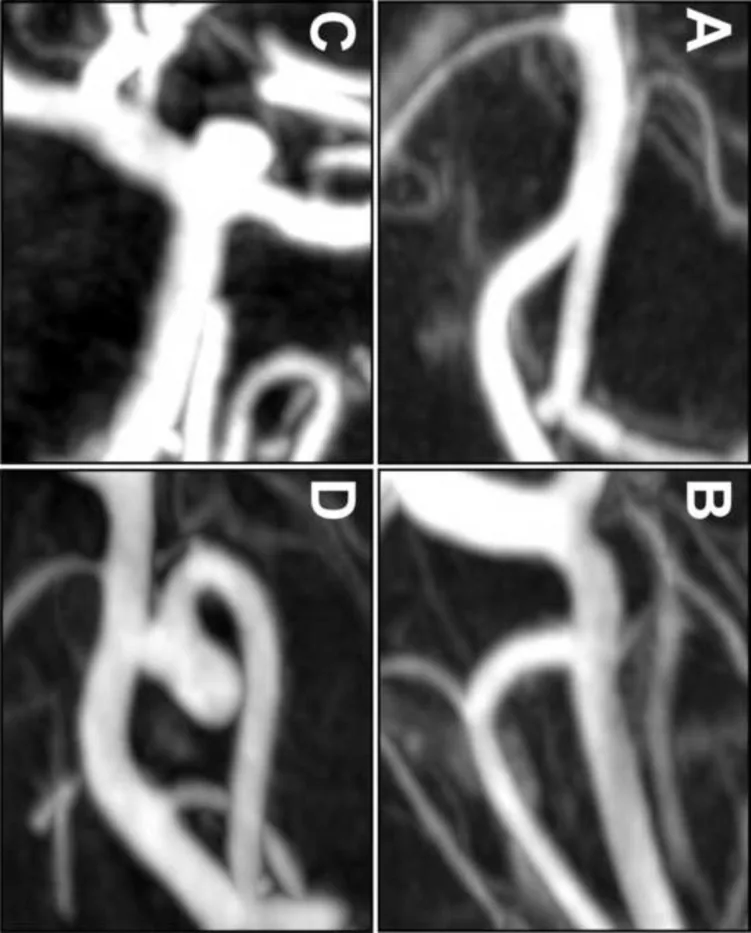
The authors measured vessel widths in 3D angiogram images of 159 middle cerebral artery bifurcations, 62 with aneurysms. Splits without aneurysms followed the rule closely (mean radius ratio of 1.05), while those with aneurysms strayed from it (0.76). Surprisingly, 37% of aneurysm-bearing splits had a branch wider than the artery feeding it, something never seen in splits without aneurysms. Aneurysms arose more often from the smaller branch.
This breakdown in normal vessel size control may play a role in how aneurysms form and deserves further study.
A plain-language summary for patients and families. It is not medical advice, and individual results vary.
Abstract
Cerebral aneurysms form preferentially at arterial bifurcations. The vascular optimality principle (VOP) decrees that minimal energy loss across bifurcations requires optimal caliber control between radii of parent (r₀) and daughter branches (r1 and r2): r₀(n)=r₁(n)+r₂(n), with n approximating three. VOP entails constant wall shear stress (WSS), an endothelial phenotype regulator. We sought to determine if caliber control is maintained in aneurysmal intracranial bifurcations. Three-dimensional rotational angiographic volumes of 159 middle cerebral artery (MCA) bifurcations (62 aneurysmal) were processed using 3D gradient edge-detection filtering, enabling threshold-insensitive radius measurement. Radius ratio (RR)=r₀(3)/(r₁(3)+r₂(3)) and estimated junction exponent (n) were compared between aneurysmal and non-aneurysmal bifurcations using Student t-test and Wilcoxon rank-sum analysis. The results show that non-aneurysmal bifurcations display optimal caliber control with mean RR of 1.05 and median n of 2.84. In contrast, aneurysmal bifurcations had significantly lower RR (0.76, p<.0001) and higher n (4.28, p<.0001). Unexpectedly, 37% of aneurysmal bifurcations revealed a daughter branch larger than its parent vessel, an absolute violation of optimality, not witnessed in non-aneurysmal bifurcations. The aneurysms originated more often off the smaller daughter (52%) vs. larger daughter branch (16%). Aneurysm size was not statistically correlated to RR or n. Aneurysmal males showed higher deviation from VOP. Non-aneurysmal MCA bifurcations contralateral to aneurysmal ones showed optimal caliber control. Aneurysmal bifurcations, in contrast to non-aneurysmal counterparts, disobey the VOP and may exhibit dysregulation in WSS-mediated caliber control. The mechanism of this focal divergence from optimality may underlie aneurysm pathogenesis and requires further study.
Abstract as indexed in PubMed (PMID 25242132). Copyright the publisher.
Cite this paper
Baharoglu MI, Lauric A, Wu C, Hippelheuser J, Malek AM. Deviation from optimal vascular caliber control at middle cerebral artery bifurcations harboring aneurysms. J Biomech 47(13):3318-24. 2014. doi:10.1016/j.jbiomech.2014.08.012 PMID: 25242132.