2026 · Hemodynamics & imaging
Morphological characteristics of healthy and aneurysmal internal carotid artery bifurcations
Lauric A, Malek AM.
J Neurosurg 144(5):1054-1063, 2026.
PMID 41569720 · DOI 10.3171/2025.8.JNS25106
In plain language
The point where the internal carotid artery splits into its two main branches deep in the brain is a high-risk spot for aneurysms. Using 3D angiograms of 194 of these splits, this study compared those with and without aneurysms.
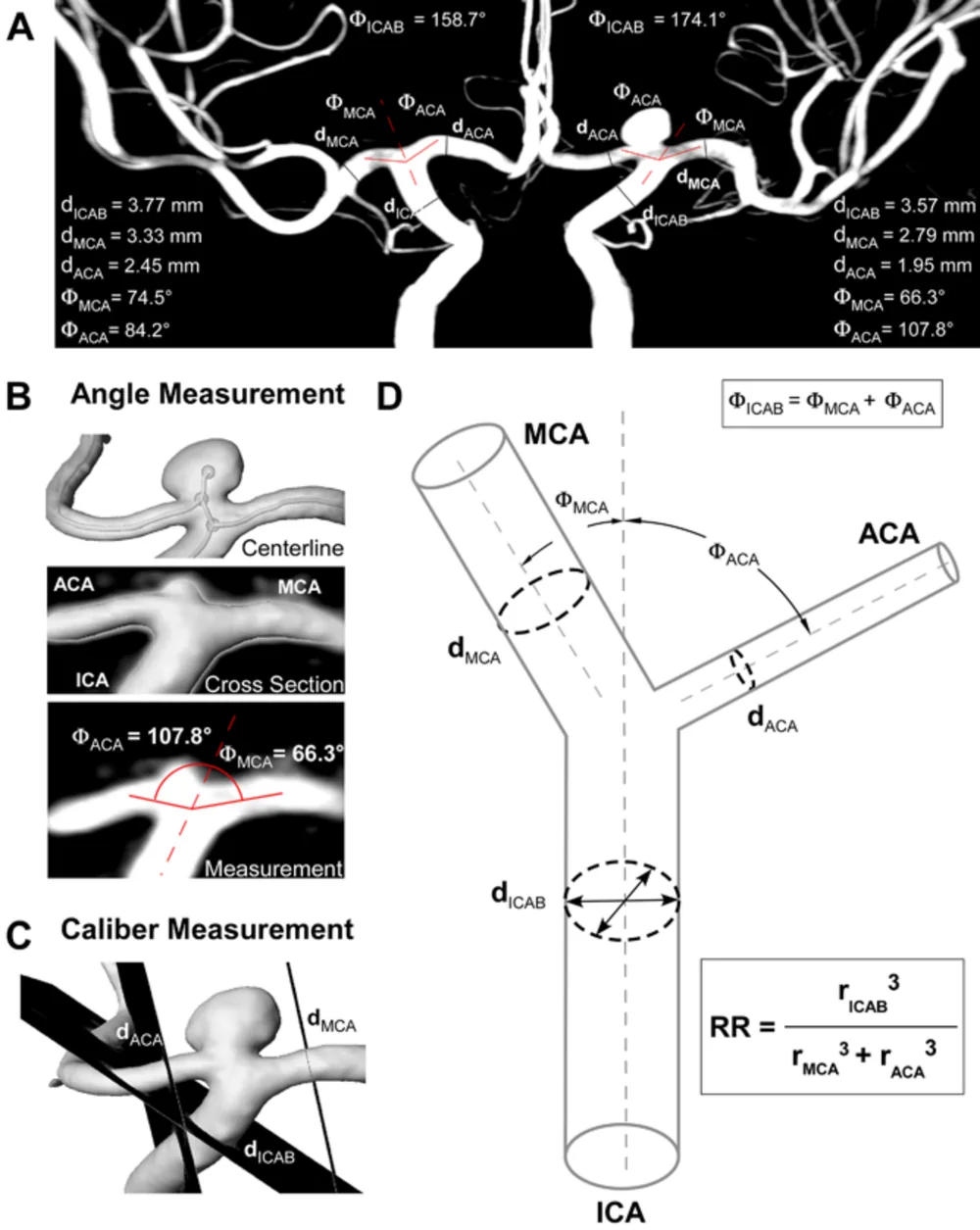
Splits that carried aneurysms opened at a noticeably wider angle, especially on the side of the middle cerebral artery branch. Aneurysms also almost always formed where the first segment of the anterior cerebral artery was the larger or an equal-sized branch.
Measuring these angles could help doctors judge which arteries are prone to aneurysms.
A plain-language summary for patients and families. It is not medical advice, and individual results vary.
Abstract
Objective
Internal carotid artery (ICA) bifurcation (ICAB) aneurysms carry high rupture risk, treatment challenges, and recurrence due to complex morphology and origination patterns. Given their relatively low incidence, research on ICAB morphology is limited. This study analyzed ICAB morphology in aneurysmal, contralateral, and healthy bifurcations, highlighting bilateral differences, anterior cerebral artery (ACA) dominance, and deviations from the vascular optimality principle (VOP).
Methods
A total of 194 angiographic volumes (40 aneurysmal, 28 contralateral, 126 healthy) were evaluated. ICAB morphology included parent/daughter vessel diameters and angle between the ICA and middle cerebral artery (MCA; ФMCA), angle between the ICA and ACA (ФACA), total ICAB angle (ФICAB; ФMCA + ФACA). Aneurysm characteristics (size, neck, origination) and VOP parameters (radius ratio [RR] and junction exponent [n]) were evaluated. Bilateral analysis accounted for ACA dominance.
Results
Compared with controls, aneurysmal ICABs exhibited wider ΦMCA (57.22° ± 12.22° vs 43.74° ± 9.41°, p < 0.001; area under the curve [AUC] = 0.83) and ΦICAB (160.27° ± 16.16° vs 143.66° ± 10.74°, p < 0.001; AUC = 0.79), but not ΦACA, in univariate, multivariate (AUC = 0.85), and bilateral analyses. Angle thresholds of 51.7° for ΦMCA and 152.4° for ΦICAB were identified. Aneurysms originated predominantly off the apex (65%) and ACA (30%). Most occurred on ICABs with dominant (31%) and codominant (58%) A1 segments. Aneurysm neck, but not size, correlated with ΦMCA and ΦICAB, but not ΦACA. In controls, ΦMCA was larger and ΦACA smaller on the dominant A1 side, with no ΦICAB difference. There was no statistically significant difference in RR and n values regardless of aneurysm presence and dominance status.
Conclusions
Aneurysmal ICABs have wider bifurcation angles that are more predominant on the MCA side compared with healthy controls. Only 10% of the aneurysms were found to occur on ICABs with the nondominant A1 segment. A1 dominance status influences bifurcation morphology not only in aneurysmal ICABs but also in healthy controls. These findings underline the importance of ICAB morphology for the likelihood of aneurysm presence, an association that can inform clinical decisions and may serve in predictive analytics.
Abstract as indexed in PubMed (PMID 41569720). Copyright the publisher.
Cite this paper
Lauric A, Malek AM. Morphological characteristics of healthy and aneurysmal internal carotid artery bifurcations. J Neurosurg 144(5):1054-1063. 2026. doi:10.3171/2025.8.JNS25106 PMID: 41569720.