2007 · Devices & clinical
Decompressive hemicraniectomy for the treatment of intractable intracranial hypertension after aneurysmal subarachnoid hemorrhage
Schirmer CM, Hoit DA, Malek AM.
Stroke 38(3):987-92, 2007.
PMID 17272765 · DOI 10.1161/01.STR.0000257962.58269.e2
In plain language
Aneurysmal subarachnoid hemorrhage is bleeding around the brain from a burst aneurysm. Sometimes pressure inside the skull rises and does not respond to medicines or fluid drainage. Decompressive hemicraniectomy removes a large piece of skull on one side and patches the brain's covering to give the swollen brain room.
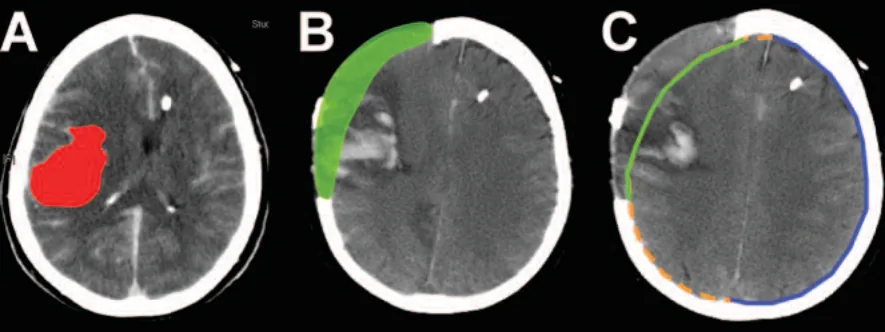
This study describes 16 patients who had this surgery a median of 2 days after admission. It lowered pressure from an average of 350 to 147 mm H2O. Eleven patients (69%) survived, and at a median follow-up of 450 days, 7 of them (64%) had outcomes ranging from no symptoms to moderate disability. Surgery within 48 hours of the bleeding was linked to better results: 6 of 8 patients did well, compared with 1 of 8 who had later surgery.
Earlier surgery appeared to work better.
A plain-language summary for patients and families. It is not medical advice, and individual results vary.
Abstract
Background and purpose
Decompressive hemicraniectomy and duroplasty (DHCD) can improve survival in patients with severe cerebral edema. We present our clinical experience with DHCD for the treatment of refractory elevated intracranial pressure (ICP) in patients with aneurysmal subarachnoid hemorrhage (aSAH).
Methods
DHCD was performed in 16 patients (11 female; median age, 49.5 years) with aSAH (11 Hunt-Hess grade 4 to 5) for sustained ICP >250 mm H(2)O refractory to maximal medical treatment and cerebrospinal fluid drainage at a median of 2 days from admission. Half of the patients were treated with endovascular coiling and the other half with surgical clipping.
Results
DHCD (mean flap size, 8536 mm(2)) reduced ICP from 350+/-157 to 147+/-124 mm H(2)O. Eleven patients survived (69%), and at latest follow-up (median, 450 days), 7 (64%) had a modified Rankin score of 0 to 3 and 4 (36%) a score of 4 to 5. Peak herniated brain volume was inversely associated with good outcome (P<0.005). Early craniectomy performed within 48 hours after the aSAH was associated with better outcome: 6 of 8 patients had good outcomes (75%) compared with 1 of 8 patients in whom late decompression was performed (P<0.01). Midline shift, Hunt-Hess grade, presence of hemorrhage, hematoma volume, craniectomy area, peak ICP, and relative ICP reduction were not associated with outcome in this patient population.
Conclusions
DHCD is a useful adjunct modality for management of refractory intracranial hypertension in patients with high-grade aSAH, even in the absence of large intraparenchymal hemorrhage. In our series, long-term outcome was better in patients who underwent early intervention.
Abstract as indexed in PubMed (PMID 17272765). Copyright the publisher.
Cite this paper
Schirmer CM, Hoit DA, Malek AM. Decompressive hemicraniectomy for the treatment of intractable intracranial hypertension after aneurysmal subarachnoid hemorrhage. Stroke 38(3):987-92. 2007. doi:10.1161/01.STR.0000257962.58269.e2 PMID: 17272765.