2013 · Hemodynamics & imaging
Angular remodeling in single stent-assisted coiling displaces and attenuates the flow impingement zone at the neck of intracranial bifurcation aneurysms
Gao B, Baharoglu MI, Malek AM.
Neurosurgery 72(5):739-48; discussion 748, 2013.
PMID 23328687 · DOI 10.1227/NEU.0b013e318286fab3
In plain language
When a single stent is used to help coil a wide-necked aneurysm at a vessel branch point, it tends to straighten the vessels. The effect of this straightening on blood flow was not known.
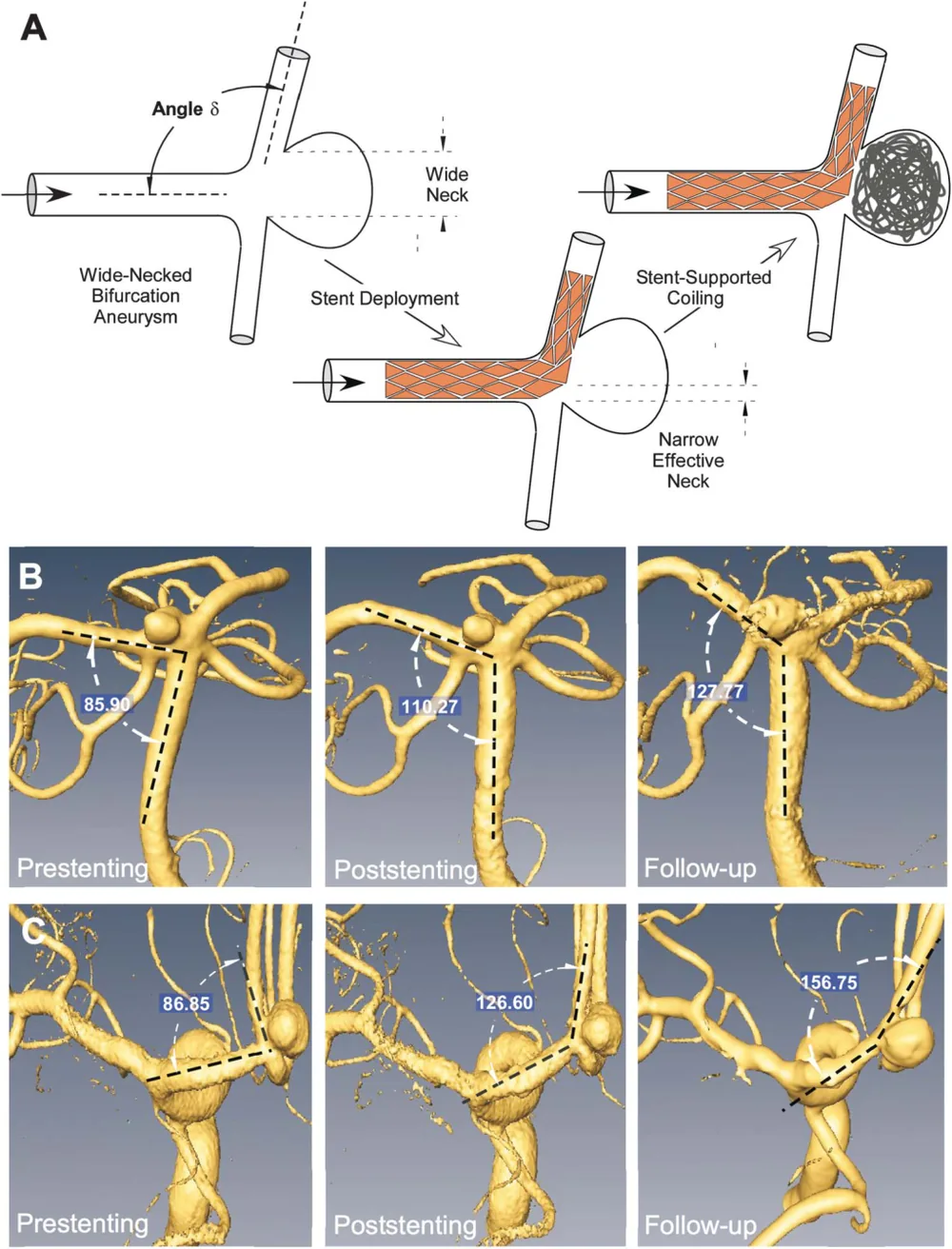
Using 3D angiography from 14 patients and computer flow simulations, the authors digitally removed the aneurysm to isolate the effect of the stent. Stenting widened the branch angle from 107.3° to 144.9°. This lowered the pressure at the tip of the branch point and moved the spot where blood strikes the wall (the flow impingement zone) by about 1.48 millimeters toward the unstented branch, while also making that zone narrower.
The authors describe this as a favorable, newly recognized effect of stenting.
A plain-language summary for patients and families. It is not medical advice, and individual results vary.
Abstract
Background
Self-expanding intracranial stent-assisted coiling of bifurcation aneurysms has recently been shown to straighten target cerebral vessels, a phenomenon with unknown hemodynamic effect.
Objective
To investigate the impact of angular remodeling in aneurysms treated with single stent-assisted coiling with the use of computational fluid dynamic techniques.
Methods
Fourteen patients (7 women, mean age 55) who underwent stent coiling of 14 wide-necked bifurcation aneurysms were included based on the availability of high-resolution 3-dimensional rotational angiography. Pretreatment data sets underwent virtual aneurysm removal to isolate the effect of stenting. Wall shear stress and pressure profiles obtained from constant flow input computational fluid dynamic analysis were analyzed for apical hemodynamic changes.
Results
Stenting increased the bifurcation angle with significant straightening immediately after treatment and at follow-up (107.3° vs. 144.9°, P < .001). The increased stented angle at follow-up led to decreased pressure drop at the bifurcation apex (12.2 vs. 9.9 Pa, P < .003) and migration of the flow impingement zone (FIZ) toward the contralateral nonstented daughter branch by a mean of 1.48 ± 0.2 mm. Stent-induced angular remodeling decreased FIZ width separating peak apical wall shear stress (3.4 vs. 2.5 mm, P < .004). Analysis of FIZ distance measured from the parent vessel centerline showed it to be linearly (r = .58, P < .002) and FIZ width inversely correlated (r = .46, P < .02) to vessel bifurcation angle.
Conclusion
Stent-induced angular remodeling significantly altered bifurcation apex hemodynamics in a favorable direction by blunting apical pressure and inducing the narrowing and migration of the FIZ, a novel response to intracranial stenting that should be added to intimal hyperplasia and flow diversion.
Abstract as indexed in PubMed (PMID 23328687). Copyright the publisher.
Cite this paper
Gao B, Baharoglu MI, Malek AM. Angular remodeling in single stent-assisted coiling displaces and attenuates the flow impingement zone at the neck of intracranial bifurcation aneurysms. Neurosurgery 72(5):739-48; discussion 748. 2013. doi:10.1227/NEU.0b013e318286fab3 PMID: 23328687.