2013 · Hemodynamics & imaging
Y-stent coiling of basilar bifurcation aneurysms induces a dynamic angular vascular remodeling with alteration of the apical wall shear stress pattern
Gao B, Baharoglu MI, Cohen AD, Malek AM.
Neurosurgery 72(4):617-29; discussion 628-9, 2013.
PMID 23277371 · DOI 10.1227/NEU.0b013e3182846d9f
In plain language
Wide-necked aneurysms at the top of the basilar artery, where it splits into two branches, can be treated by placing two small stents in a Y shape and filling the aneurysm with coils. How this changes the shape of the vessels and the blood flow was unknown.
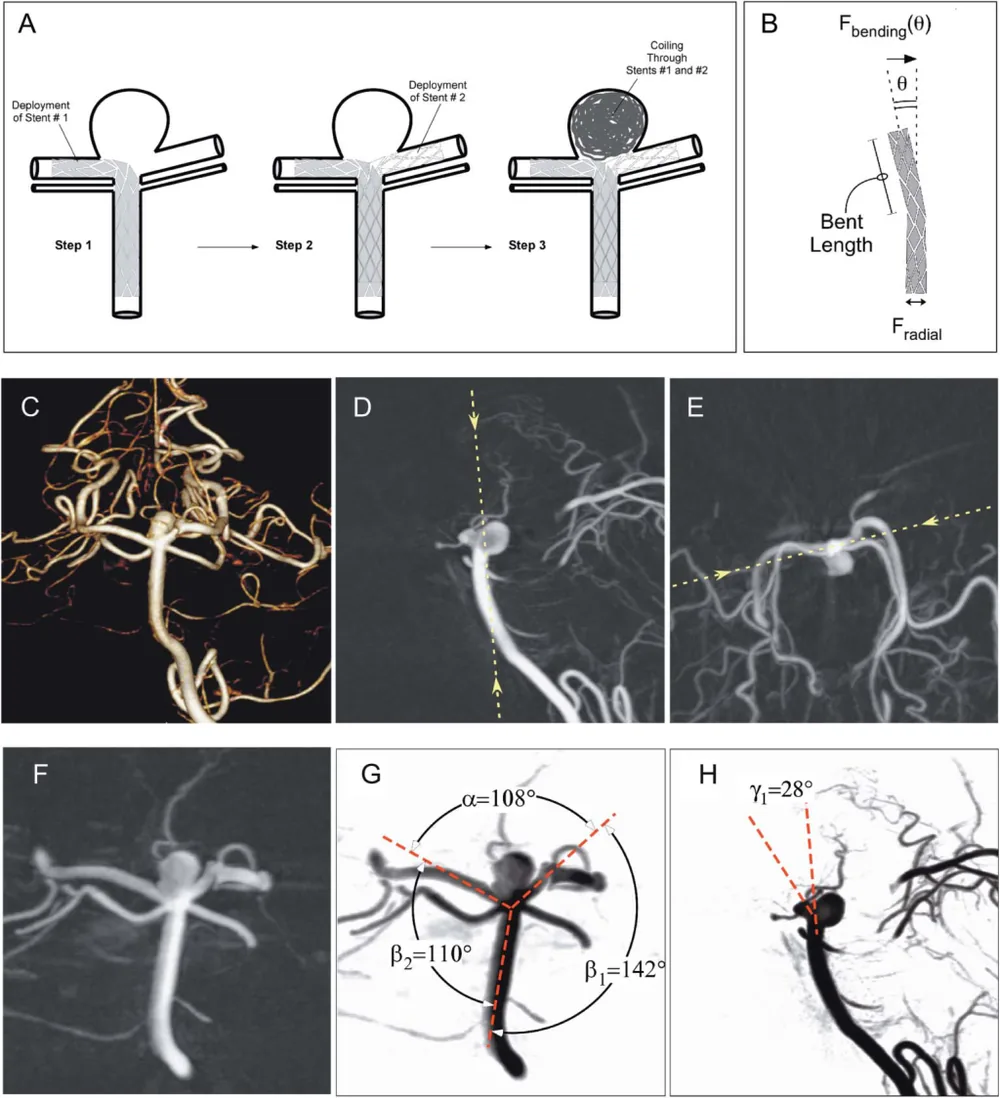
In 15 patients, the authors measured vessel angles on 3D angiography before and after treatment and used computer flow simulations. The stents straightened the branch point right away and continued to reshape it over the following months, narrowing the angle between the two branches from 150 degrees to 113 degrees. This shifted the area of high wall shear stress (the rubbing force of flowing blood) away from the aneurysm neck and toward the coil mass.
Stents appear to change the forces around an aneurysm by reshaping the vessels themselves.
A plain-language summary for patients and families. It is not medical advice, and individual results vary.
Abstract
Background
Although wide-necked basilar bifurcation aneurysms are treated with Y-stent coiling, the effect of this intervention on vessel configuration and hemodynamics is unknown.
Objective
To investigate the immediate and delayed effects of Y-stenting using self-expanding microstents on basilar bifurcation architecture and hemodynamics.
Methods
Fifteen patients underwent basilar Y-stent coiling and imaging with rotational angiography. Vascular angles were measured between proximal P1 segments of the posterior cerebral arteries (α) and between the basilar artery and each P1 segment (β(1,2)) in the anteroposterior and γ(1,2) sagittal planes. Patient-specific computational fluid dynamic analysis was used to estimate wall shear stress (WSS) changes with treatment.
Results
In the anteroposterior plane, Y-stenting significantly decreased angle α and increased β angles immediately after stent coiling (P < .05 and P < .01, respectively) in a continued dynamic remodeling that progressed further in later months; sagittal γ angles also decreased (P < .0001). This novel stent-induced geometric progressive remodeling resulted in effective straightening and narrowing of the basilar bifurcation angle α (150.0 degrees vs 113 degrees, P < .0001) with significant correlation (r = 0.39, P < .05) between pretreatment proximal P1 angles and maximal angular change. Computational fluid dynamic analysis showed the angular remodeling led to significant narrowing of the WSS interpeak at the apex, redirecting high WSS away from the neck transition zone with native vessel toward the inert coil mass.
Conclusion
Y-configuration stent coiling induced immediate and, more significantly, a previously undefined delayed cerebrovascular remodeling. This progressive stent-induced angular remodeling alters perianeurysmal hemodynamics, independent of the flow-diverting properties of stent struts, thus shifting the balance of hemodynamic forces affecting aneurysm development and evolution.
Abstract as indexed in PubMed (PMID 23277371). Copyright the publisher.
Cite this paper
Gao B, Baharoglu MI, Cohen AD, Malek AM. Y-stent coiling of basilar bifurcation aneurysms induces a dynamic angular vascular remodeling with alteration of the apical wall shear stress pattern. Neurosurgery 72(4):617-29; discussion 628-9. 2013. doi:10.1227/NEU.0b013e3182846d9f PMID: 23277371.