2008 · Devices & clinical
Iatrogenic vasospasm in carotid artery stent angioplasty with distal protection devices
Schirmer CM, Hoit DA, Malek AM.
Neurosurg Focus 24(2):E12, 2008.
PMID 18275288 · DOI 10.3171/FOC/2008/24/2/E12
In plain language
Carotid stenting opens a narrowed neck artery to the brain with a small mesh tube. Distal protection devices, small filters placed beyond the narrowing to catch loose debris, lower the risk of stroke during the procedure. Older fixed-basket filters are rigidly attached to their guidewire, while newer mobile-basket filters can move along it.
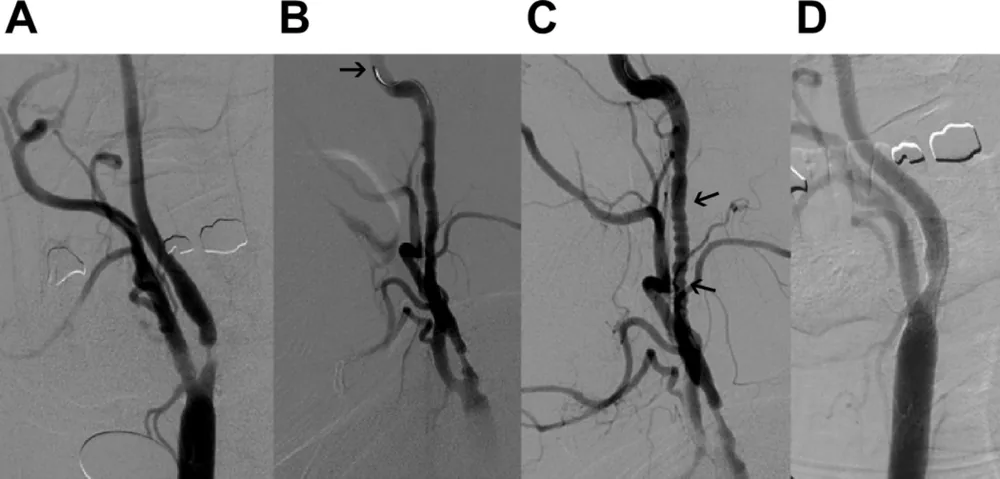
This study reviewed 40 carotid arteries in 37 patients treated with a fixed-basket filter (FilterWire EX), a mobile-basket filter, or no filter. Vasospasm, a temporary tightening of the artery, occurred in 8 of 12 cases (67%) with the fixed-basket filter, compared with 3 of 22 (14%) without a filter and 1 of 6 (17%) with mobile-basket filters. The spasm resolved on its own in every case.
The authors recommend second-generation mobile-basket filters to reduce this risk.
A plain-language summary for patients and families. It is not medical advice, and individual results vary.
Abstract
Object
Distal protection devices (DPDs) have decreased the risk of embolic stroke among patients with carotid artery (CA) disease undergoing CA stent placement. The FilterWire EX is a first-generation fixed-basket DPD with a filter rigidly attached to a guidewire. Second-generation mobile-basket DPDs (RX Accunet or SpiderFX) allow movement of the filter relative to the guidewire and can thus reduce the potential for vessel irritation, vasospasm, or intimal injury during CA stent placement.
Methods
Stent angioplasty was attempted in 40 CAs (37 patients) using the fixed-basket FilterWire DPD, a second-generation mobile-basket DPD, or no protection in 12, 6, and 22 arteries, respectively. Clinical presentation, angiographic details relating to the incidence of vasospasm or dissection, and clinical outcome data were recorded and analyzed.
Results
Vasospasm was associated with use of the fixed-basket FilterWire device (8 [67%] of 12 cases) compared with the bare unfiltered guidewire group (3 [14%] of 22) and the second-generation mobile-basket DPD group (1 [17%] of 6, p < 0.004). Secondary angioplasty was also associated with intraprocedural vasospasm. In a multivariate analysis, FilterWire use was an independent risk factor for vasospasm (p < 0.0003).
Conclusions
A high incidence of vasospasm was observed following CA stent placement procedures in which the fixed-basket FilterWire EX DPD was used but not in unprotected CA stent placement or procedures in which a second-generation mobile-basket DPD was used. Although this phenomenon was self-limited in all instances, vasospasm should be considered a risk of these devices and may predispose to more serious vascular injury. Coronary artery stent placement should be performed with a second-generation mobile-basket DPD to minimize the risks of embolic complications and iatrogenic vascular injury.
Abstract as indexed in PubMed (PMID 18275288). Copyright the publisher.
Cite this paper
Schirmer CM, Hoit DA, Malek AM. Iatrogenic vasospasm in carotid artery stent angioplasty with distal protection devices. Neurosurg Focus 24(2):E12. 2008. doi:10.3171/FOC/2008/24/2/E12 PMID: 18275288.