2010 · Hemodynamics & imaging
Aneurysm inflow-angle as a discriminant for rupture in sidewall cerebral aneurysms: morphometric and computational fluid dynamic analysis
Baharoglu MI, Schirmer CM, Hoit DA, Gao BL, Malek AM.
Stroke 41(7):1423-30, 2010.
PMID 20508183 · DOI 10.1161/STROKEAHA.109.570770
In plain language
Doctors would like to know which brain aneurysms are more likely to rupture. This study examined the inflow angle, the angle between the artery and the main direction of the aneurysm bulge, in sidewall aneurysms (those that bulge from the side of a vessel rather than at a branch point).
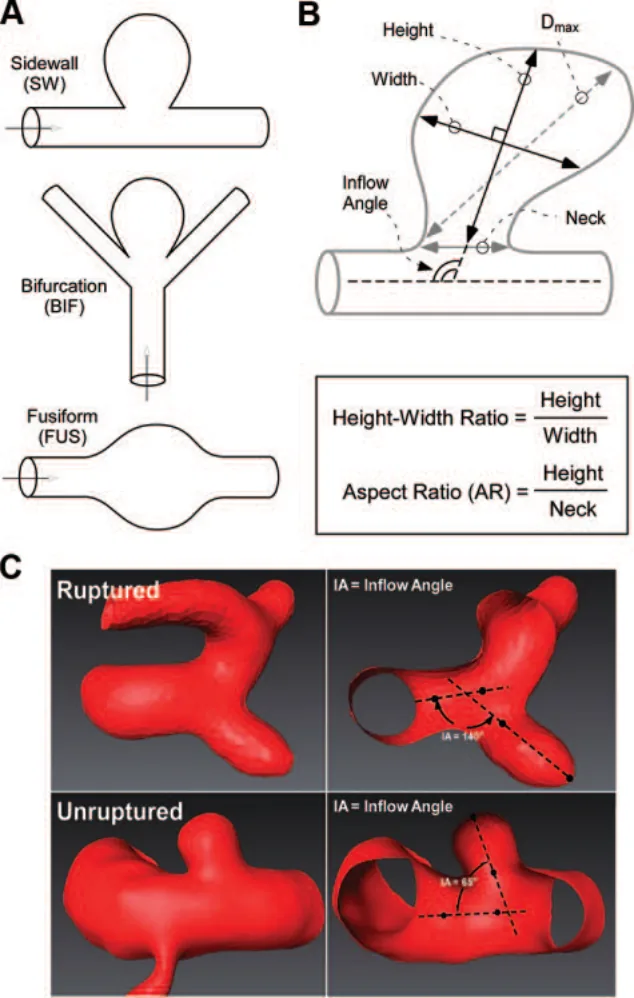
In 116 aneurysms from 102 patients, ruptured aneurysms had a wider inflow angle on average (124.9 degrees versus 105.8 degrees). After accounting for other measures, only the inflow angle and the height to width ratio remained independent markers of rupture. Computer simulations of blood flow showed that a wider angle drives faster flow and more energy deeper into the dome, with stronger forces on the wall.
The authors recommend including inflow angle in future studies of rupture risk.
A plain-language summary for patients and families. It is not medical advice, and individual results vary.
Abstract
Background and purpose
The ability to discriminate between ruptured and unruptured cerebral aneurysms on a morphological basis may be useful in clinical risk stratification. The objective was to evaluate the importance of inflow-angle (IA), the angle separating parent vessel and aneurysm dome main axes.
Methods
IA, maximal dimension, height-width ratio, and dome-neck aspect ratio were evaluated in sidewall-type aneurysms with respect to rupture status in a cohort of 116 aneurysms in 102 patients. Computational fluid dynamic analysis was performed in an idealized model with variational analysis of the effect of IA on intra-aneurysmal hemodynamics.
Results
Univariate analysis identified IA as significantly more obtuse in the ruptured subset (124.9 degrees+/-26.5 degrees versus 105.8 degrees+/-18.5 degrees, P=0.0001); similarly, maximal dimension, height-width ratio, and dome-neck aspect ratio were significantly greater in the ruptured subset; multivariate logistic regression identified only IA (P=0.0158) and height-width ratio (P=0.0017), but not maximal dimension or dome-neck aspect ratio, as independent discriminants of rupture status. Computational fluid dynamic analysis showed increasing IA leading to deeper migration of the flow recirculation zone into the aneurysm with higher peak flow velocities and a greater transmission of kinetic energy into the distal portion of the dome. Increasing IA resulted in higher inflow velocity and greater wall shear stress magnitude and spatial gradients in both the inflow zone and dome.
Conclusions
Inflow-angle is a significant discriminant of rupture status in sidewall-type aneurysms and is associated with higher energy transmission to the dome. These results support inclusion of IA in future prospective aneurysm rupture risk assessment trials.
Abstract as indexed in PubMed (PMID 20508183). Copyright the publisher.
Cite this paper
Baharoglu MI, Schirmer CM, Hoit DA, Gao BL, Malek AM. Aneurysm inflow-angle as a discriminant for rupture in sidewall cerebral aneurysms: morphometric and computational fluid dynamic analysis. Stroke 41(7):1423-30. 2010. doi:10.1161/STROKEAHA.109.570770 PMID: 20508183.